

What did LHCb announce on 3 November?
On 3 November, CERN announced that LHCb had found evidence for a particularly rare decay of a neutral B meson. The final particles are a muon and an antimuon. The paper was first submitted to arXiv on 30 October; a public announcement and a paper appearing online are different dates.
The new analysis uses collisions recorded in 2024 and 2025, combined with earlier measurements. Its combined statistical significance is 3.2 standard deviations, often written as 3.2 sigma. The current paper is a preprint, not something we should describe as a completed peer-review process.
If the names are unfamiliar, begin with our Large Hadron Collider guide. The accelerator supplies collisions, while detectors record signals and researchers work out which processes best explain them. New analysis can happen long after the collisions themselves.
What are B mesons, muons and antiparticles?
A proton is not elementary: it contains quarks. A B meson is another composite particle, but it belongs to a different family. Mesons contain a quark and an antiquark. The B mesons discussed here involve the bottom flavour, also called beauty. Beauty is a label, not a statement about what the particle looks like.
A muon is different. It is an elementary lepton, like the electron, with the same negative electric charge but a larger mass. The positively charged antimuon is its antiparticle. Do not confuse a muon with a meson just because their names look similar.
Decay means one particle changes into other particles through an allowed interaction. It does not mean a little object gradually wears away. The final particles do not have to have been sitting inside the original particle, waiting to be released.
The neutral B meson can decay in several ways. A branching fraction is the probability of one particular route. The Standard Model predicts that this two-muon route occurs roughly once in ten billion relevant B-meson decays. That number is not the number of collisions the experiment must record to guarantee one event.
There is a related particle called a B-sub-s meson, whose two-muon decay has already been observed. It is not the same measurement. The paper studies both channels, but the new evidence concerns the still rarer B-zero channel.
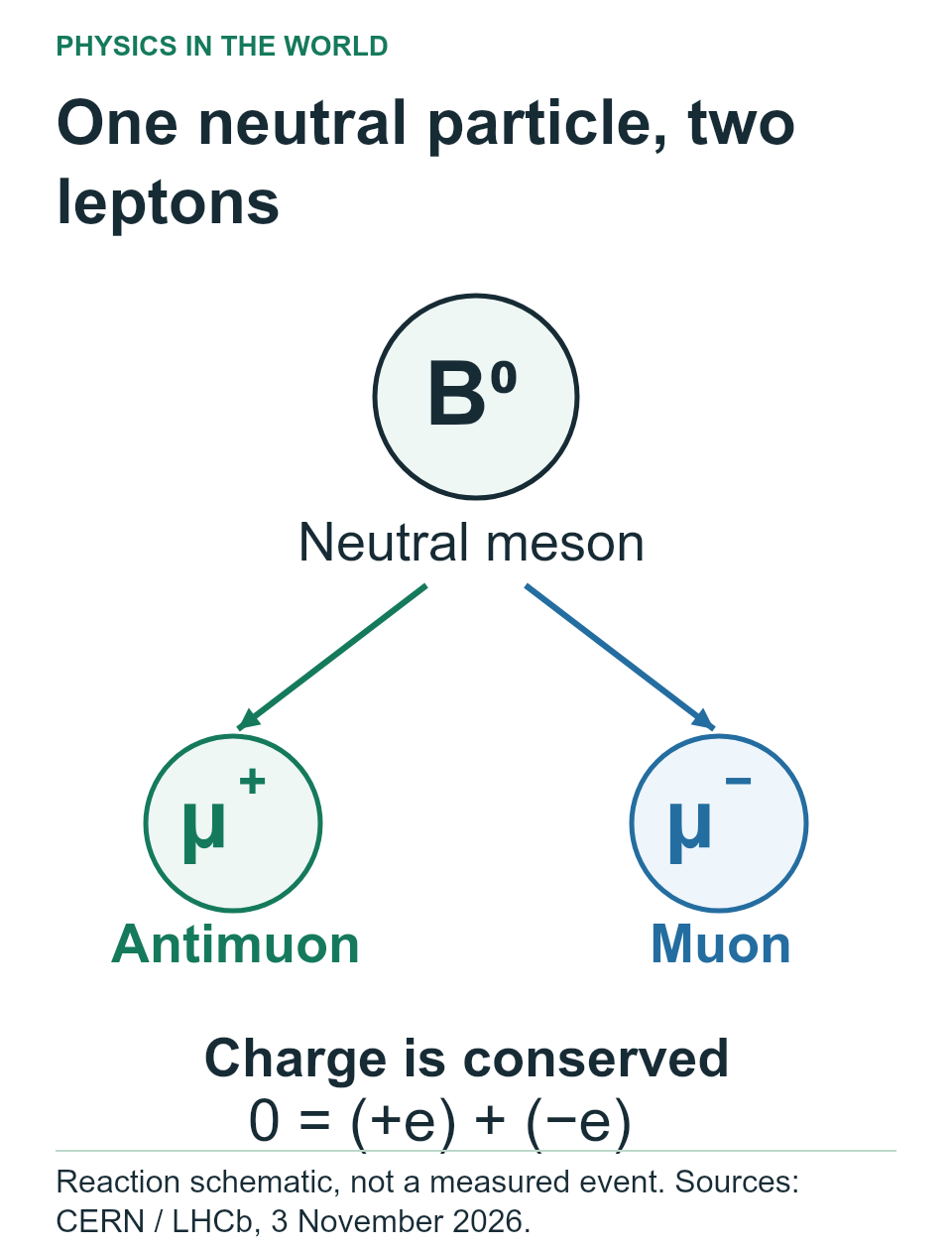
Worked equations
The decay and its electric-charge check
The superscript zero indicates a neutral B meson. It is not a nuclear mass number. The plus and minus signs identify the final particles' electric charges.
- Initial charge equals total final charge: 0 = (+e) + (-e)
How do you find a decay this rare?
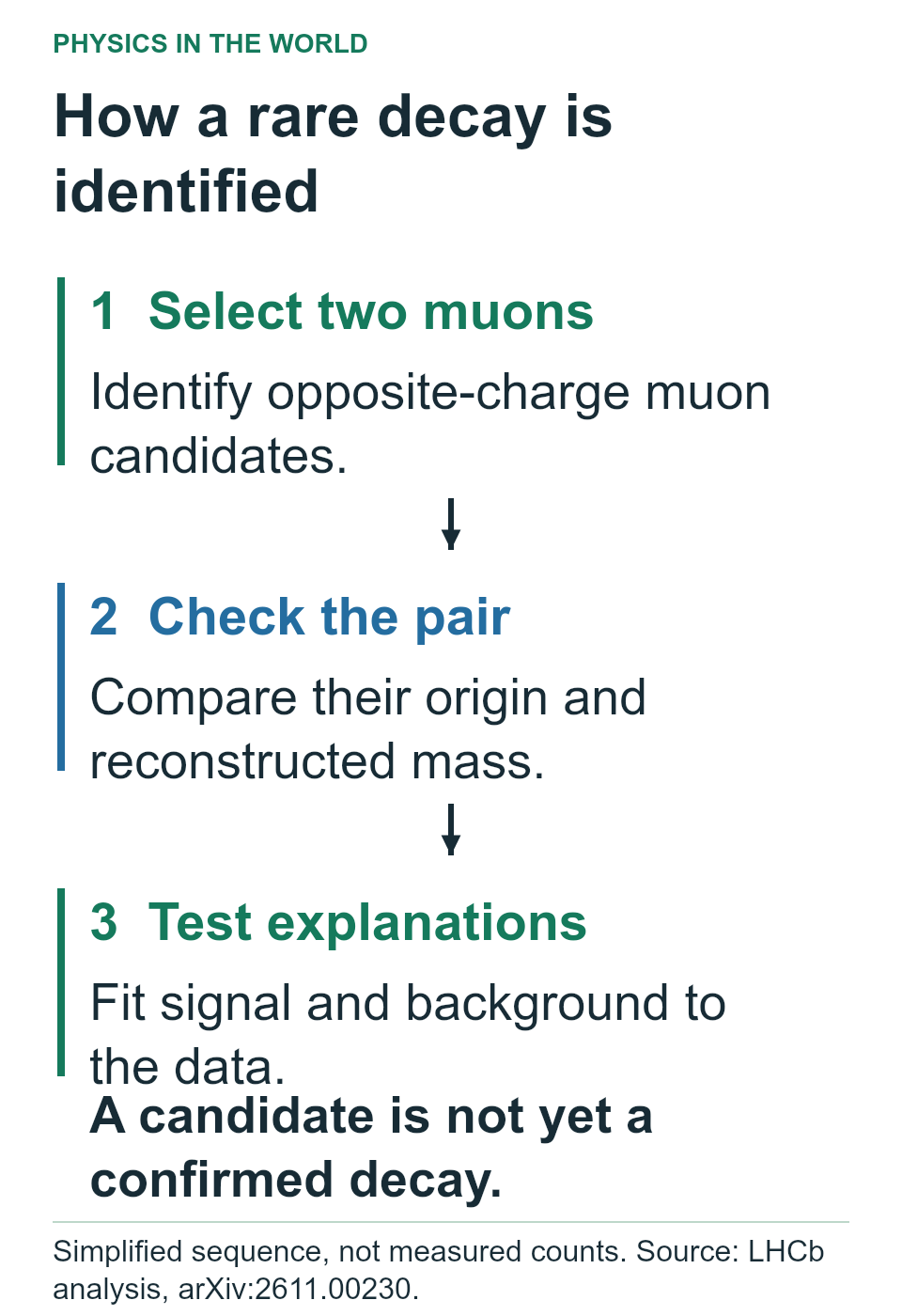
Two muons are a useful starting point, but not a complete answer. Other particle processes can produce muons, and particles can sometimes be misidentified. Those alternatives form the background against which the rare signal must be tested.
Researchers use the measured tracks to ask whether the two particles could have come from a common decay point. Their measured energies and momenta also allow the original particle's mass to be reconstructed. The relevant quantity is their combined invariant mass, not the sum of two muon rest masses.
The analysis compares the measured distributions with descriptions of signal and background. It uses detector calibration, selection methods and checks on other samples. Simply counting every opposite-charge muon pair would mix different processes together.
A rare decay is useful because its predicted rate is sensitive to quantum contributions from other particles. Some proposed additions to the Standard Model would change that rate. Agreement with the prediction constrains those proposals; it does not prove that no undiscovered particles exist.
This is one reason a data scientist needs more than a convincing graph. The choice of model, the quality of the measurements and the checks on alternative explanations all affect what a result can support.
The conservation laws you already know
Start with classification. The particles and radiation notes distinguish quarks, leptons and composite particles. A B meson is a hadron; a muon is not. The fundamental particles and isotopes resource gives OCR A pupils the same useful starting point.
Next check electric charge. The initial particle is neutral. The final muon and antimuon have equal and opposite charges, so their total charge is also zero. Two charged final particles do not imply that charge has been created.
At A level, lepton number adds another check. A muon has lepton number plus one and an antimuon minus one. Their total is zero, as it is for the initial meson. Keeping an additive quantity conserved is different from keeping the number of particles unchanged.
Conserving charge and lepton number is necessary, but it does not tell you how likely a process is. Nor does it identify the event uniquely: background processes must obey conservation laws too. A correct conservation check is a filter on an explanation, not proof of it.
Energy and momentum also have to balance. Rest energy can contribute to the final particles' energy. This is why a particle decay is not restricted to releasing objects that were already stored as constituents of the parent.
A Level stretch: evidence is not the same as observation
The 3.2-sigma result describes how incompatible the data are with the background-only description within the statistical model. It passes the usual three-sigma convention for evidence, but not the five-sigma convention for an observation. Sigma is not a percentage showing how close a project is to completion.
It is also not the probability that the Standard Model is true, or the probability that any one candidate event is genuine. Those are different questions. The uncertainty and data analysis notes help with the broader habit of asking what a measurement actually establishes.
A larger comparable sample can reduce relative statistical fluctuations, making a small excess easier to assess. It does not automatically remove a calibration error or an incorrect background model. Better statistics and better control of systematic effects are separate jobs.
Earlier combined LHCb and CMS work had reported evidence for this channel that was not confirmed in later updates. That history matters: the new result is the first evidence from a single experiment, not a claim that nobody had ever looked for or reported a hint of the decay before.
Key words
Quick pupil questions
Did CERN discover a new particle in November 2026?
This LHCb result is evidence for a rare decay of an already known neutral B meson. It is not the discovery of a new particle or force.
What does one in ten billion mean in the LHCb result?
It approximately describes the predicted fraction of relevant B-meson decays that produce a muon-antimuon pair. It does not refer to all proton collisions or guarantee an event after a fixed number of trials.
What is the difference between a muon and a meson?
A muon is an elementary lepton. A meson is a composite hadron containing a quark and an antiquark.
Why is the result called evidence rather than an observation?
The combined statistical significance is 3.2 sigma, above the usual evidence threshold but below the five-sigma convention for an observation in particle physics.