

What is the Large Hadron Collider?
The Large Hadron Collider, or LHC, is a machine for investigating matter at very small scales. It sits underground at CERN, near Geneva on the border between France and Switzerland. CERN is the research organisation; the LHC is one of its accelerators.
Its name is a useful introduction. Large refers to the roughly 27-kilometre ring. A hadron is a particle made from quarks that takes part in the strong interaction; the proton is one example. Collider means two beams are brought into collisions.
ATLAS, CMS, ALICE and LHCb are the four main detector experiments around the ring. They do not all make the same measurements. The accelerator supplies the collisions; each experiment uses its instruments and analysis to answer particular physics questions.
Follow a proton: accelerate, steer, collide
Start with a proton, the positively charged particle found in an atomic nucleus. A hydrogen atom has one proton and one electron. Removing the electron provides a proton that can be put into an accelerator.
The proton does not begin at its final energy. CERN uses a sequence of smaller accelerators before particles enter the LHC. Each stage prepares the beam for the next.
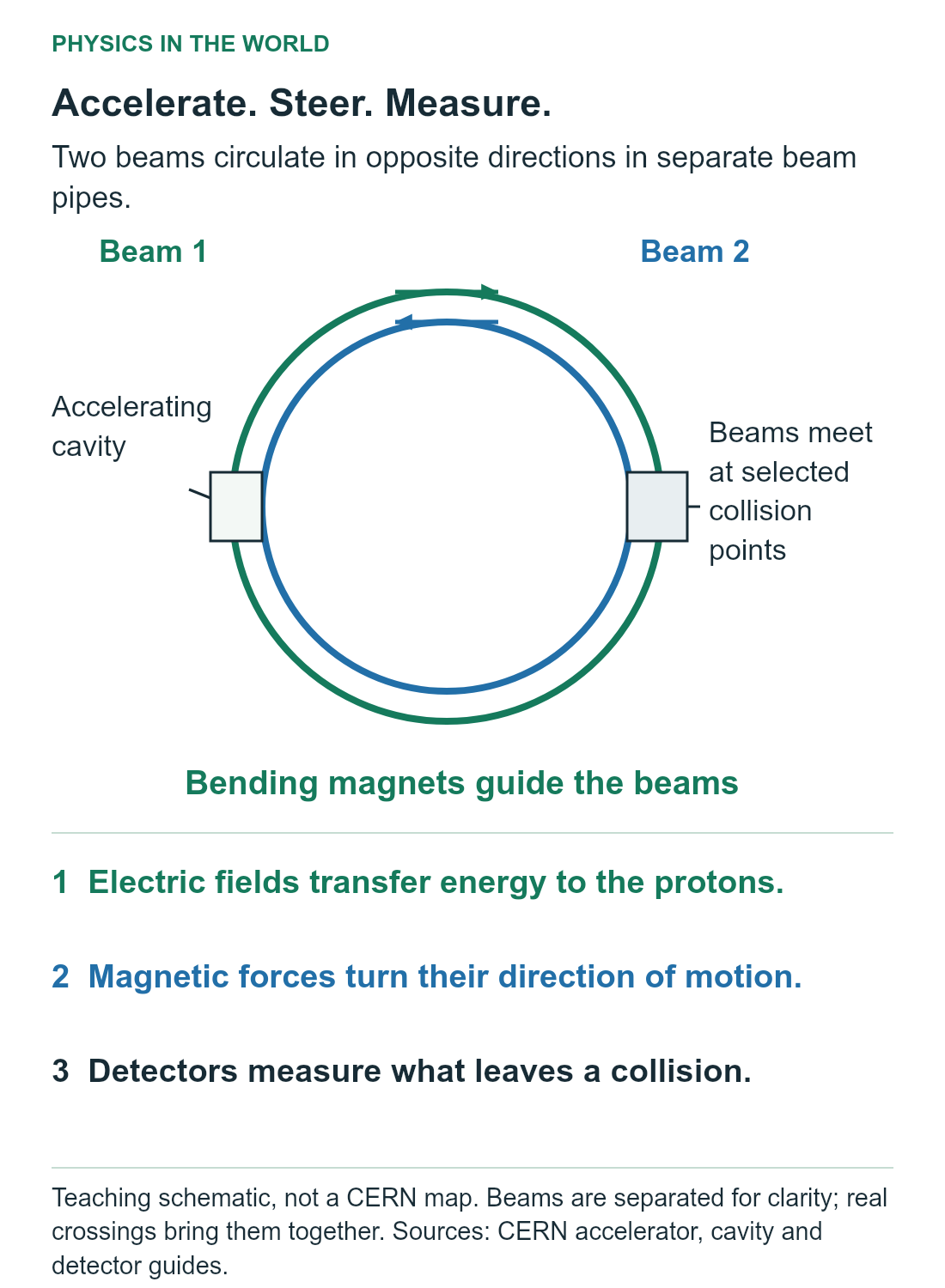
Inside the LHC, electric fields in radiofrequency cavities transfer energy to the particles. Radiofrequency means the fields change repeatedly at a carefully controlled frequency. The arriving bunches of protons are timed so the field pushes them forwards at the right part of its cycle.
The bending magnets do a different job. A magnetic force acts sideways on a moving charged particle. This keeps the beam turning around the ring instead of continuing along a straight line. Other magnets focus the beam, helping keep its particles together.
The beams travel in opposite directions in separate pipes with very little gas inside. Reducing the gas reduces unwanted interactions along the way. At selected points the beams are brought together, with detectors surrounding the collision region.
A collision can produce particles that were not present in the incoming beams. Some of the available energy can appear as the rest energy of new particles. This is not just smashing a proton to reveal objects stored inside it. Total energy, momentum and electric charge must still balance.
Worked equations
Energy gained through a potential difference
For a positive particle accelerated through a voltage, these are the magnitudes of the energy gain and accelerating potential difference. This explains an accelerating gap; the changing cavity fields and beam timing need a fuller model.
Why a more energetic beam needs stronger bending magnets
For motion perpendicular to a uniform magnetic field, larger momentum means a larger bending radius unless the magnetic field is increased. This form uses momentum and remains useful when the particles are relativistic.
What can scientists learn from the collisions?
A detector records signals from particles passing through its different layers. Charged particles can leave tracks. Other detector sections measure deposited energy, and outer systems help identify muons. Physicists combine these measurements to work out which explanation fits an event.
Short-lived particles often decay before they can travel through much of the detector. Researchers infer their production from the particles left afterwards. An event display is therefore a reconstruction from measurements, not a photograph of every particle that existed.
The best-known LHC discovery is the Higgs boson, announced by ATLAS and CMS in 2012. It supplied evidence for a part of the Standard Model that explains how elementary particles acquire mass. It did not answer every question about matter or account for all the mass of ordinary objects.
Other work measures known processes more precisely, studies matter containing heavy quarks and tests ideas about the early Universe. Our ATLAS single-top-quark article gives a current example: better analysis can reveal a rare process in data recorded years earlier.
The GCSE and A-level physics in the machine
For GCSE, begin with charge, forces and energy transfer. A proton is positive, so an electric field can exert a force on it. If that force acts along its motion, energy is transferred to the proton. The electric fields revision page develops that connection.
Speed and velocity are not interchangeable. A particle turning at constant speed still changes velocity because its direction changes. It is accelerating and needs a resultant force towards the centre of its path.
At A level, magnetic fields and charged-particle motion explain the steering. For motion perpendicular to a magnetic field, the magnetic force is perpendicular to the velocity. That force changes direction without doing work on the particle. Electric fields supply the beam's energy gain.
The particles and radiation notes help separate protons, quarks and leptons. A proton is a composite baryon, made from two up quarks and a down quark. An electron is a lepton. A collider result may concern an elementary particle, a composite particle or a new way of producing something already known.
An electrical engineer working on an accelerator has to connect these ideas to power supplies, controls and reliable instruments. Cooling, vacuum systems, computing and mechanical engineering are also essential to making useful physics measurements.
A Level stretch: more energy is not simply more speed
LHC protons are already travelling very close to the vacuum speed of light. Adding more energy does not let them pass that limit. Their energy and momentum can increase substantially while their speed changes only slightly. Do not apply the low-speed kinetic-energy formula to predict an LHC proton travelling faster than light.
The momentum relationship explains why magnets matter even when the speed is almost unchanged. In a ring with a fixed path radius, a higher beam momentum needs a stronger bending field. The relevant quantity is momentum, not just a rough statement that the beam is fast.
Many bending magnets use superconducting coils, cooled to very low temperatures. The coils can carry large currents with negligible electrical resistance in the superconducting state. The whole accelerator still needs electrical power, including for cooling; superconducting does not mean energy-free.
Collision energy and collision rate are different too. Higher energy can make heavier final states accessible, provided the necessary conservation laws and production processes allow them. More collisions improve the chances of measuring rare events. Increasing one quantity does not automatically increase the other.
As of October 2026, the LHC is in Long Shutdown 3 for the High-Luminosity upgrade, with restart planned for 2030. Data analysis continues while the machine is being changed. Treat that as a dated operational note; the field and detector ideas above apply beyond one running schedule.
Key words
Quick pupil questions
What does the Large Hadron Collider do?
The LHC accelerates beams of protons or ions and brings them into collisions. Experiments measure the particles produced to investigate matter and its interactions.
Why does the LHC need magnets?
Bending magnets exert sideways forces on the moving charged particles to keep them turning around the ring. Other magnets focus the beams. Electric fields in accelerating cavities supply the energy gain.
Where is the Large Hadron Collider?
It is underground at CERN, near Geneva, in a roughly 27-kilometre ring crossing the border between France and Switzerland.
What has the LHC discovered?
Its best-known discovery is the Higgs boson, announced by ATLAS and CMS in 2012. LHC experiments also study new composite particles and measure known particle interactions in detail.
Is the LHC running in 2026?
The LHC entered Long Shutdown 3 in June 2026 for major upgrades. As of October 2026 the High-Luminosity restart is planned for 2030, while researchers continue analysing earlier collision data.