

What did ATLAS announce this week?
The ATLAS collaboration announced a new result on 26 October: it has observed a rare production process called s-channel single-top-quark production at the LHC. The associated research paper was first posted on arXiv on 8 October and submitted to Physical Review Letters.
Top quarks were already known. The process had also been observed at the Tevatron in 2014 by combining results from CDF and D0. What is new is observing it at the LHC, with a single experiment providing the evidence.
ATLAS analysed proton-proton collisions recorded during Run 2 at a collision energy of 13 TeV. The collider is now in an upgrade shutdown, but earlier recordings remain available for analysis. Our Large Hadron Collider guide explains the difference between running the machine and studying its data.
What is a top quark, and what does s-channel mean?
A proton contains quarks. In the school model, its three valence quarks are two up quarks and one down quark. A top quark is a different type of quark, much heavier than an up or down quark. It is elementary: we do not describe it as a collection of smaller particles, as we do a proton.
The familiar uud label counts the proton's three valence quarks. Its full quantum structure also includes gluons and quark-antiquark pairs. A quark and an antiquark can therefore participate in an interaction even though the LHC brings two protons together.
Producing a single top quark means producing it without an accompanying top antiquark. It does not mean only one particle comes out of the collision. Other particles must carry the remaining charge, energy and momentum.
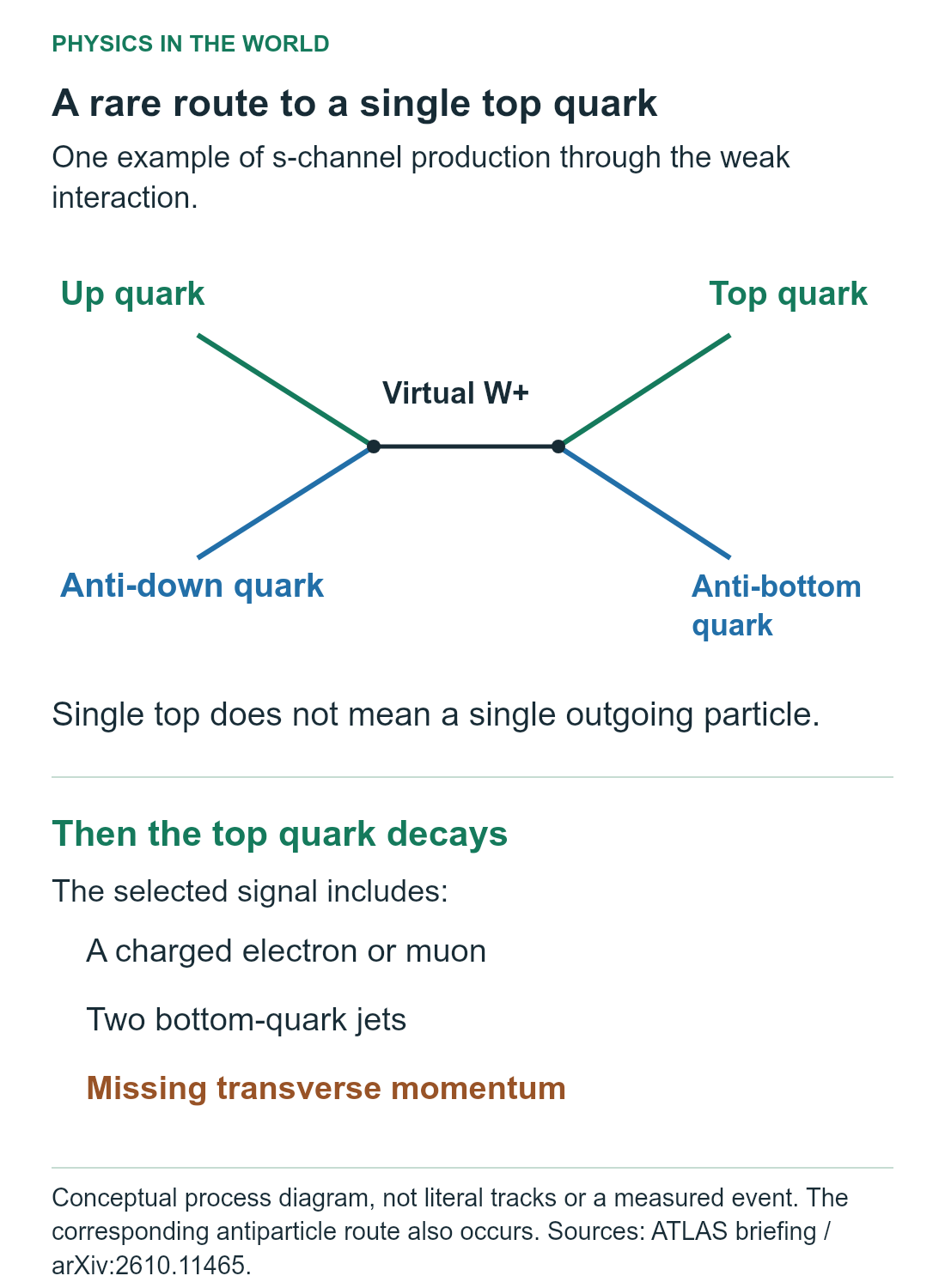
In the route studied here, a quark and an antiquark interact through a W boson, a particle associated with the weak interaction, to produce a top quark and a bottom antiquark. Physicists call this the s-channel. The label distinguishes this arrangement from other ways of producing a single top quark.
The W in this production step is virtual: it is an intermediate part of the interaction. Do not imagine a separate, ordinary W particle sitting in the detector and later decaying into this heavier pair. A process diagram describes an interaction, not a film of tiny objects moving between the lines.
The top quark decays too quickly to leave a long track of its own. One useful decay route ultimately gives a charged electron or muon, a neutrino and particles associated with a bottom quark. Together with the other bottom antiquark, that gives a pattern the detector can look for.
Worked equations
One example: check the total electric charge
This shows the incoming and outgoing quarks for one example of the production process, mediated by a virtual W-plus boson. Bars indicate antiquarks. Other allowed incoming flavours and the charge-conjugate process are included in the full analysis.
- Initial charge, in units of the elementary charge: 2/3 + 1/3 = 1
- Final charge, in the same units: 2/3 + 1/3 = 1
How do researchers find such a rare process?
Finding the right final particles is a start, but other processes can produce similar signals. ATLAS had to distinguish the rare signal from much more common background events. A striking event display alone cannot make that distinction.
The analysis improved the identification of bottom-quark jets and used a graph neural network to help separate signal-like and background-like patterns. A jet is a group of particles associated with an energetic quark or gluon. It is not one bare quark leaving a coloured trail.
The network used relationships between measured objects, including their momenta and directions. Researchers then compared distributions in the data with signal and background predictions. They also used control regions, selections of events that help check the background description.
Observing this weak-interaction process gives another way to test the top quark's behaviour. The measured rate agrees with the Standard Model. That is useful evidence about an established theory; this result does not claim to have found a new force.
Quarks, charge and tracks: the school physics
The particles and radiation revision page gives the starting point: quarks, antiquarks and composite particles. A proton is a baryon containing three valence quarks. A top quark is itself a quark. The word particle can refer to either, so classification matters.
A familiar weak-interaction example is beta decay, where quark character changes and W bosons appear in the description. The top-quark process is not beta decay, but the same broad interaction is involved. OCR A pupils can build that link with the fundamental particles and isotopes resource.
Charge conservation is a useful check on the example in the diagram. An up quark has charge plus two-thirds of the elementary charge; an anti-down quark has plus one-third. The top quark and bottom antiquark carry the same respective charges. The total is unchanged.
The magnetic fields and charged particles notes explain another part of the evidence. A charged track bends in a magnetic field. Its curvature, together with the field and charge, helps determine momentum. The top quark is inferred from its decay products rather than followed around such a track.
A neutrino usually leaves no directly measurable track in this detector. Researchers infer missing momentum in the plane perpendicular to the beams by balancing what the detector did measure. A mismatch also has possible instrumental causes, which have to be checked.
A Level stretch: what does 5.1 sigma tell us?
ATLAS reports a statistical significance of 5.1 standard deviations, often called 5.1 sigma. Under the background-only model used for the analysis, a fluctuation at least as signal-like as the observed result would be very unlikely. The value passes the usual five-sigma convention for an observation in particle physics.
This is not the probability that the Standard Model is true, the probability that an individual event is genuine, or a guarantee that every possible modelling error has been excluded. Significance depends on the statistical model and how uncertainties are treated.
Significance and precision answer different questions. The reported production-rate measurement has an uncertainty of about 20%, even though the observation exceeds five sigma. You can have strong evidence that a process occurs while still wanting a more precise measurement of its rate.
The measurement uncertainty revision page helps separate random fluctuations, calibration and assumptions in a model. More events can reduce some statistical uncertainty. They do not automatically correct a wrong detector calibration or an inaccurate background model.
There is also a useful lesson in the timing. The paper reanalyses data used in an earlier search, with improved selection and modelling. Better questions and better methods can extract more from an existing measurement. A data scientist faces that same challenge in many fields.
Key words
Quick pupil questions
Has ATLAS discovered a new top quark?
No. The top quark was already known. The October 2026 result is the first LHC observation of a rare production route called s-channel single-top production, and the first observation of that route by one experiment.
What does single-top production mean?
It means a top quark or top antiquark is produced without an accompanying top partner. Other particles are still produced; it is not a collision with only one outgoing particle.
Was this process observed before?
Yes. CDF and D0 observed it in a combined Tevatron result in 2014. ATLAS has now observed it independently at the LHC.
Does 5.1 sigma mean new physics has been discovered?
No. It describes the statistical evidence for this process relative to the background model. The measured production rate agrees with the Standard Model.
How can ATLAS publish new results while the LHC is shut down?
Experiments keep their recorded data. Researchers can improve the selection, calibration and analysis of earlier collisions while the accelerator is being upgraded.