

How does active noise cancellation work?
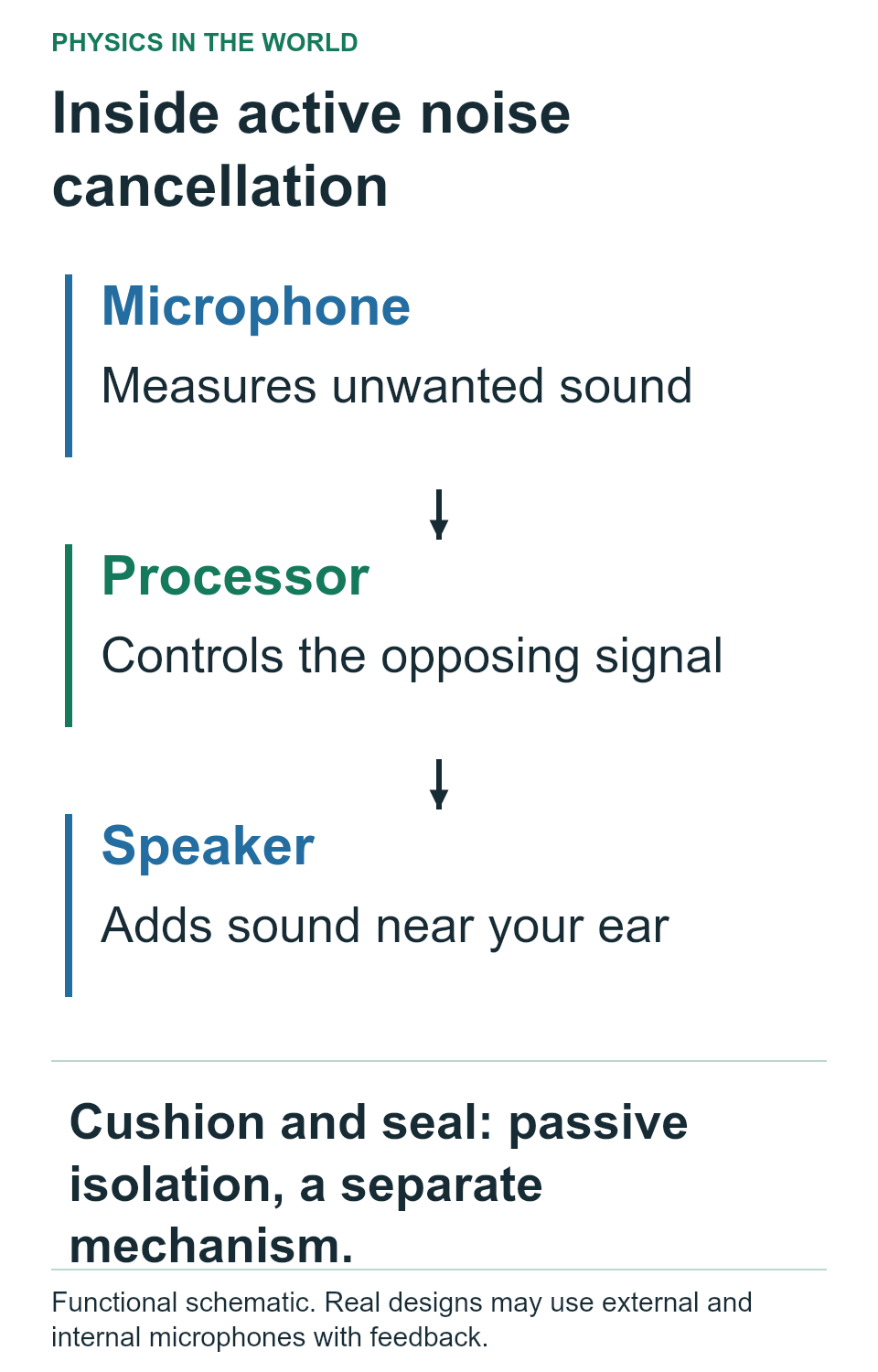
Noise-cancelling headphones are a useful example of school physics doing a real job. Instead of only putting a barrier between your ear and the noise, active noise cancellation uses a microphone, electronic processing and a speaker to reduce the sound you hear.
Manufacturers combine that active system with passive isolation from the earcups or ear tips. These are two different mechanisms. A comfortable-looking cushion does not explain the electronics, and electronics do not remove the need for a good fit.
How can adding sound make things quieter?
Sound in air is a travelling pattern of compressions and rarefactions. At a fixed point, the pressure rises and falls around its normal value. Your eardrum responds to the resulting changes.
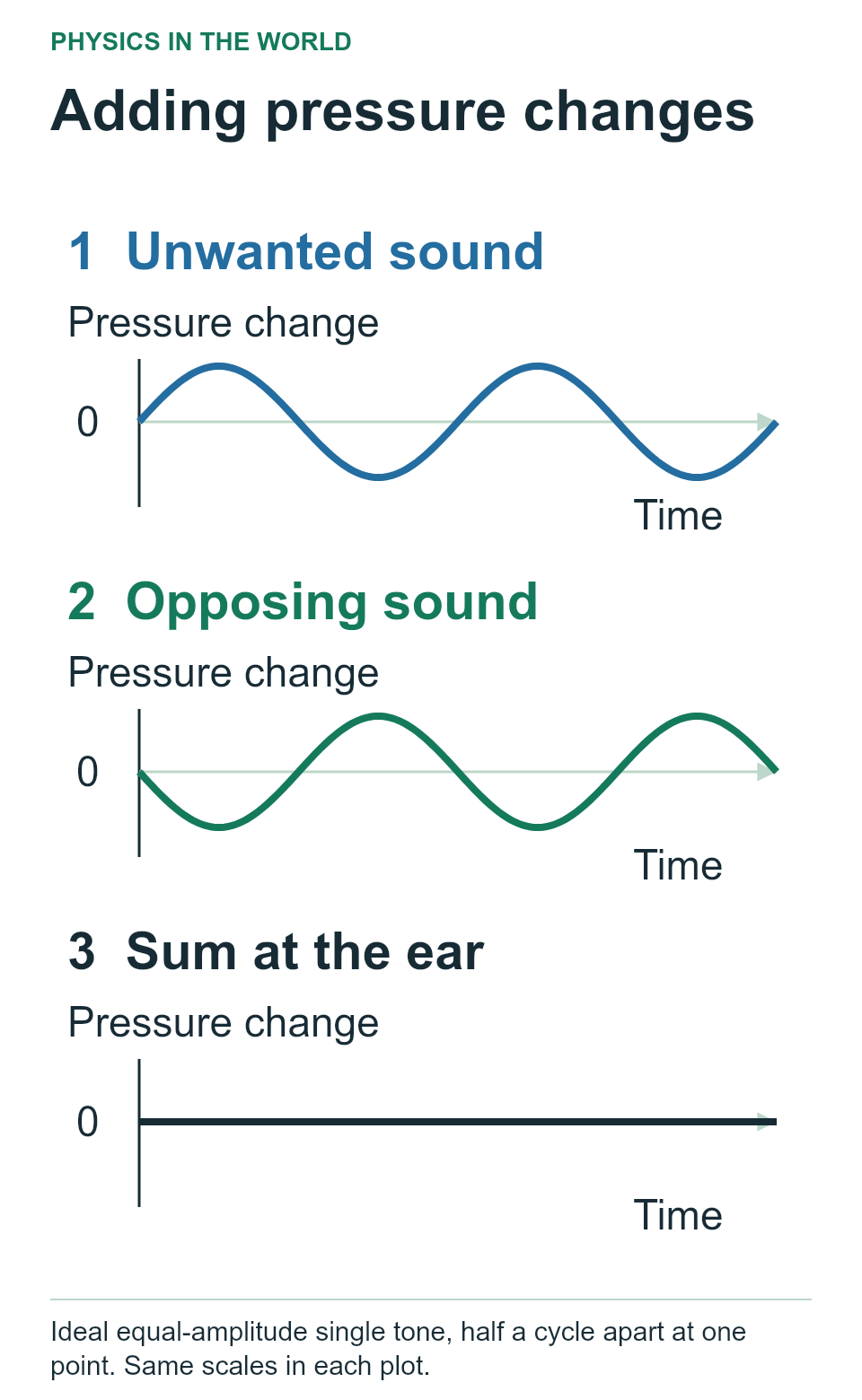
Now imagine an unwanted sound is making the pressure slightly higher at a particular instant. A speaker can produce a pressure change in the other direction at the same place and time. The two changes add together, giving a smaller total change.
For a steady, pure tone, the ideal opposing wave has the same frequency and pressure amplitude but is half a cycle out of step. When one pressure change is positive, the other is equally negative. This is destructive interference.
It is worth being precise about the word opposite. The frequencies are not opposites, and the sound does not need to travel in the opposite direction. What needs to oppose is the pressure variation where we want cancellation.
The wave properties revision page is a good starting point if frequency and amplitude still blur together. Frequency tells you how often the pattern repeats. Amplitude tells you the size of the oscillation. Matching one does not automatically match the other.
Why does ANC reduce a rumble better than a sudden voice?
A steady low rumble is a relatively manageable target. The electronics can track its changing waveform and drive the speaker to reduce it. A changing mixture of voices, sharp impacts and movement is harder to match accurately.
Time matters. The microphone, processing and speaker all introduce delays, and the sound also travels between them. The system must account for the sound that will reach the ear, not simply replay a reversed recording too late.
That helps explain why a pair of headphones can noticeably reduce a train-like drone while you still hear someone speaking. It is not evidence that interference has stopped working. The real sound field is much more complicated than one clean sine wave.
Fit matters as well. A gap around an ear tip or cushion changes the way outside sound enters and the way the speaker couples to the space near the ear. Passive isolation and active control are designed to work together.
ANC can operate without music because the cancellation signal is a separate job from playing a song. But it should not be treated as certified hearing protection, or as a way to make unlimited listening safe. Lowering music volume and taking listening breaks still matter.
Superposition, phase and amplitude: the school physics
Superposition means adding the disturbances present at the same point at the same time. For sound, we can add pressure variations. We are not adding the perceived loudness in a simple way, and we are not adding a positive sound energy to a negative sound energy.
In the ideal single-tone example, a half-cycle phase difference is 180 degrees, or pi radians. If the amplitudes also match, the pressure variations can cancel at that point. If the opposing amplitude is too small, some of the original variation remains.
The AQA waves revision notes develop this phase language and interference. A clear explanation should identify both the phase relationship and the need to compare waves where they overlap, not merely say they are out of phase.
A sound pressure-time graph often looks like a wavy line. That does not make sound in air transverse. Air particles oscillate along the direction of propagation; the vertical graph axis is pressure change, not the height of the particles.
An electrical engineer working on audio can combine wave physics with microphones, amplifiers and control software. Testing the finished device means measuring the remaining sound over a range of frequencies and fits, not only demonstrating cancellation of one laboratory tone.
A Level stretch: timing errors and the limits of cancellation
For a given processing delay, the fraction of a cycle lost is larger at higher frequency. A delay that is small beside a long low-frequency period can be a substantial phase error for a shorter period. That is one reason a perfect single-tone sketch cannot describe every real sound.
Cancellation is local. Move the listening point and the path lengths from different sources change, so the phase relationships can change too. A quiet region near an ear does not imply silence across the carriage.
Energy is still conserved. Interference changes the spatial pattern of the sound field, and the driven speaker can exchange energy with that field. Some energy is dissipated in the apparatus. The battery also supplies energy to the electronics; there is no negative-energy sound deleting energy from the Universe.
Do not automatically call the result a stationary wave. The stationary waves resource explains a particular interference pattern with fixed nodes and antinodes. An adaptive headphone controller reducing pressure near an ear is not, by itself, evidence of that full pattern.
Key words
Quick pupil questions
How do noise-cancelling headphones work?
Microphones measure unwanted sound and electronics control an added speaker signal. Destructive interference reduces the resulting pressure variations near the listener's ear.
Why can I still hear voices with noise cancellation on?
Speech changes quickly and contains many frequencies. Real ANC cannot match every component perfectly, and sound can also enter around the seal. Steady low background noise is often reduced more effectively.
Does ANC work without playing music?
Yes, in headphones that allow ANC to run on its own. Generating the cancellation signal is separate from playing music, although the active electronics still require power.
Is active noise cancellation the same as blocking sound?
No. Passive isolation uses a physical barrier or seal; ANC actively adds a controlled sound. Many headphones use both methods together.