What happened?
The CMS experiment at CERN has reported the first direct observation of a diffusion wake in quark-gluon plasma. This is a pattern left behind when a fast quark or gluon, called a parton, crosses the extremely hot and dense matter created in a heavy-ion collision.
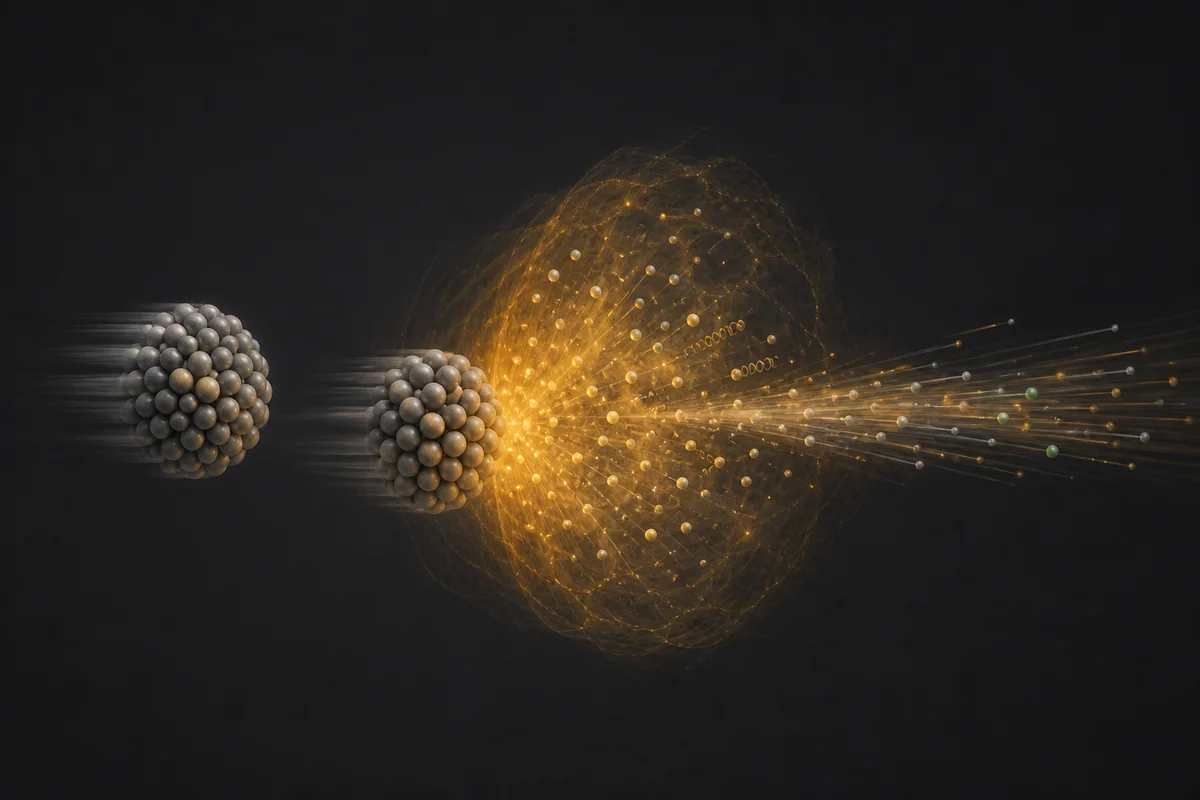
At the Large Hadron Collider, lead nuclei are accelerated to almost the speed of light and collided. For a tiny fraction of a second, the collision can produce quark-gluon plasma, a fluid-like state in which quarks and gluons are not confined inside ordinary protons and neutrons. Similar matter filled the Universe shortly after the Big Bang.
The CMS team studied pairs of back-to-back particle jets in lead-lead collisions and compared their particle patterns with proton-proton collisions. They found fewer low-momentum charged particles in the direction expected behind a jet, which is the signature predicted for a diffusion wake.
The signal in the clearest measurement was more than five standard deviations from a no-wake baseline. That does not mean every detail of quark-gluon plasma is solved, but it is strong evidence that the fast parton transfers energy and momentum to the surrounding medium in the expected way.
The simple version
A boat moving through water pushes water aside and leaves a disturbance behind it. A very fast quark or gluon moving through quark-gluon plasma can also disturb the material around it. The plasma is not water, but the wake comparison helps describe the pattern created when energy and momentum are deposited in the medium.
The wake is not a visible line that a camera photographs. CMS infers it from the directions and momenta of many particles produced in many collisions. The important clue is a depletion, or shortage, of certain particles where a simple no-wake model would expect more.
Quarks and gluons are normally trapped inside particles such as protons and neutrons by the strong nuclear force. A heavy-ion collision briefly makes conditions hot and dense enough for physicists to study how these constituents behave in a different state of matter.
The particle jets seen by the detector are made of hadrons formed after the partons leave the plasma. Physicists use their measurements of those final particles to work backwards and learn about the invisible plasma that existed a moment earlier.
Worked equations
Collision energy quoted by CMS
CMS quotes 5.02 TeV as the centre-of-mass energy per colliding pair of nucleons. It is not the energy of one final particle, but it shows the enormous energy concentration available in a lead-lead collision.
- Prefix definition: 1 TeV = 10^12 eV
- Electronvolt conversion: 1 eV = 1.602 x 10^-19 J
Why it matters
Quark-gluon plasma lets physicists test the strong interaction under conditions that are impossible to keep on Earth for more than a tiny instant. By measuring how a known high-energy jet changes as it crosses the plasma, they can learn about the plasma’s density, flow and transport properties.
The observation also links particle physics to cosmology. The Universe cooled so quickly after the Big Bang that we cannot look directly at its earliest plasma. Collider experiments make a small, short-lived version and test whether our models describe how it behaves.
This result improves the evidence available to a research scientist comparing different computer models of heavy-ion collisions. A model must explain both the particle jet and the response of the surrounding medium, not only one of them.
Physics you already know
At A Level, quarks are the constituents of hadrons such as protons and neutrons. This experiment studies a hotter state where the usual bound particles do not survive for long enough to be the best description of the system.
Momentum is a central idea. When the fast parton loses momentum, the surrounding plasma must gain it. The measured wake is evidence about where that transferred momentum appears among the particles produced later.
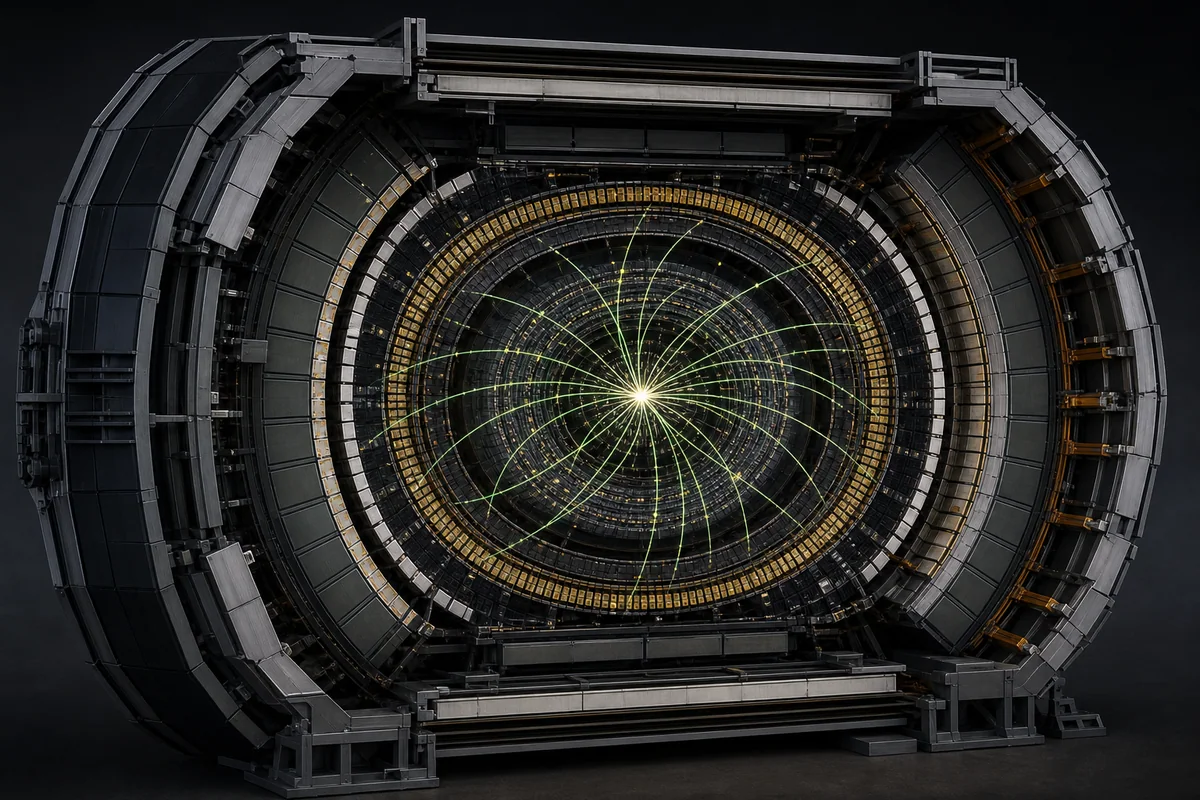
Particle accelerators are not simply machines for making new particle names. They make controlled high-energy collisions, then detectors measure tracks, energies and directions so physicists can infer what happened during an interaction too brief to see directly.
The result also develops the school idea of evidence. Scientists compare a signal with a baseline, estimate uncertainties and ask whether the difference is large enough to rule out a chance fluctuation.
Science ideas to understand
A jet is not one particle
A particle jet is a narrow spray of many final particles. It forms when a high-energy quark or gluon produces hadrons that travel in broadly similar directions.
Why use lead nuclei?
Lead nuclei contain many protons and neutrons. Colliding them can create a much larger, hotter region of quark-gluon plasma than an ordinary proton-proton collision.
The wake is inferred
The detector does not watch a parton travelling through plasma like a camera watching a boat. Physicists infer the wake from statistical patterns in the particles detected after many separate collisions.
Five standard deviations
In particle physics, a result more than five standard deviations from a null model is a conventional threshold for a discovery-level observation. It does not remove the need for independent checks and improved measurements.
A Level stretch
The word diffusion wake is slightly counter-intuitive because the clearest signal is a depletion of particles behind the jet direction. The moving parton deposits energy and momentum into the plasma, and the medium’s response redistributes the final particles rather than drawing a simple bright line.
CMS used transverse momentum, the component perpendicular to the beam direction, because particles in a collider detector spread out sideways from the incoming beams. Studying that component helps physicists compare what happens across many collision events while the beams continue along the same axis.
Centrality describes how directly two lead nuclei overlap. More central collisions create more quark-gluon plasma, and CMS observed stronger wake signals in those collisions. This is an example of testing whether the size of an effect changes in the way a physical model predicts.
The more-than-five-standard-deviation result is a measure of statistical significance, not a percentage of how much plasma was present. It means the reported signal is very unlikely under the specified no-wake statistical model; systematic uncertainties and model assumptions still matter.
Key words
Quick pupil questions
What is quark-gluon plasma?
It is an extremely hot and dense state of matter where quarks and gluons are not confined inside ordinary protons and neutrons. It existed shortly after the Big Bang and can be made briefly in heavy-ion collisions.
What did CMS observe at CERN?
CMS observed a diffusion wake: a characteristic change in the pattern of particles produced when a fast quark or gluon crosses quark-gluon plasma in a lead-lead collision.
Why is the wake compared with a boat wake?
Both involve a fast-moving object disturbing a surrounding medium. The comparison is only an analogy: quark-gluon plasma is a relativistic quantum fluid, not ordinary water.
How does this link to A Level Physics?
It links to quarks, the strong interaction, momentum conservation, energy transfer, particle accelerators, statistical evidence and the early Universe.