
Free worksheet and solutions · OCR A AS · H156
OCR A AS Physics Mean Drift Velocity Worksheet
Download a free OCR A AS Physics worksheet on mean drift velocity, I = Anev, conductor geometry and carrier number density, with worked solutions.
What is covered
Questions and skills covered
The worksheet contains 7 pages of printable questions. A separate 7-page solutions PDF makes it easy to mark, review or share answers after the activity.
- Meaning of mean drift velocity and carrier motion
- Calculations using I = Anev
- Cross-sectional area, diameter and shared-current comparisons
- Charge-carrier number density in different materials
- Application to high-current charging conductors and sensors
About this activity
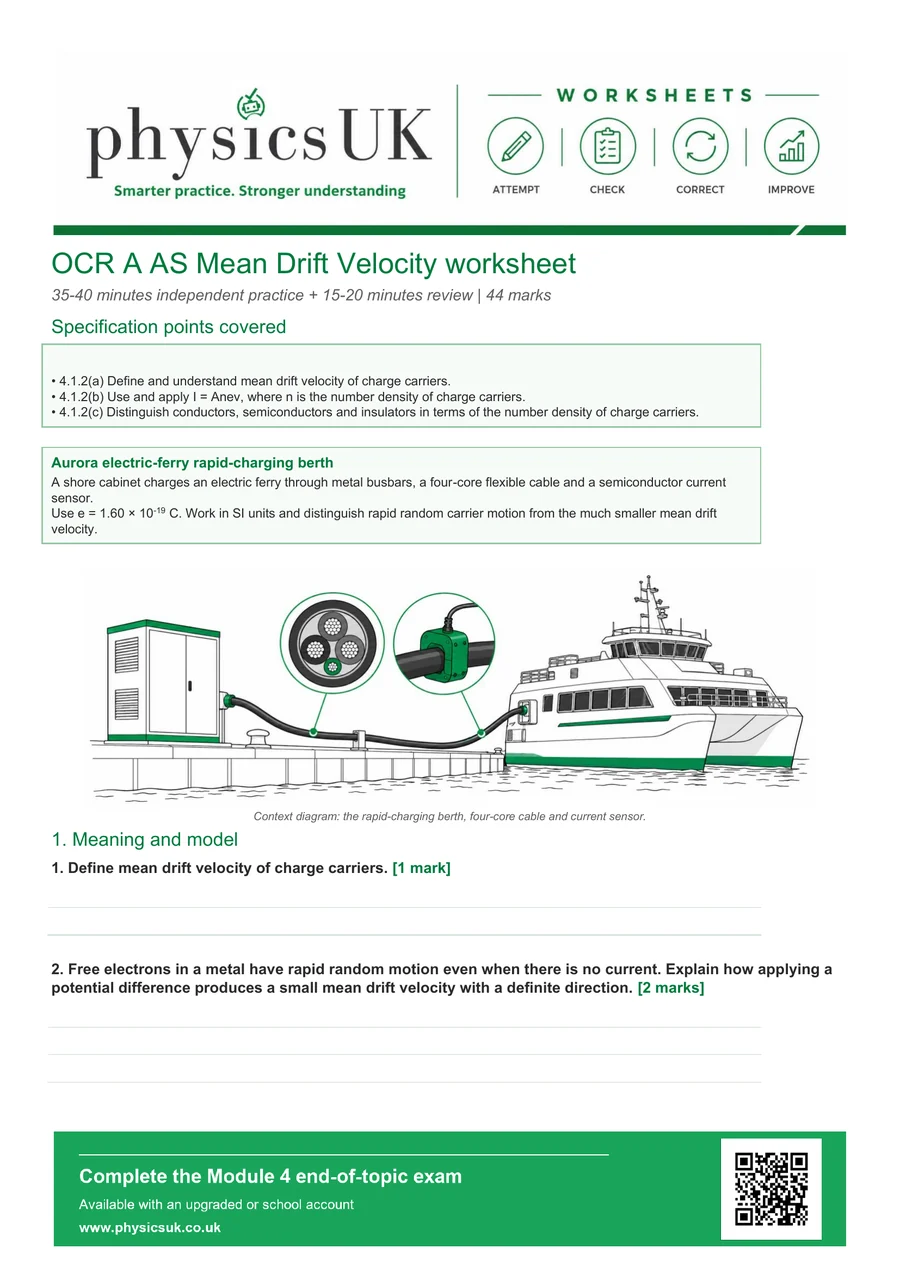
An electric-ferry charging berth connects the microscopic carrier model to busbars, a multi-core cable and a current sensor. The questions progress from defining drift velocity to calculating conductor areas and using carrier number density.
Before you start
Rearrange I = Anev, use standard form and convert areas to square metres. For a circular conductor, halve the diameter before calculating pi x radius squared.
A question from the worksheet
Question 4, worksheet page 2
A copper busbar carries 360 A. Its cross-sectional area is 4.8 x 10^-4 m^2 and its carrier number density is 8.5 x 10^28 m^-3. Calculate the mean drift velocity using e = 1.60 x 10^-19 C.
Show the answer
v = I/(Ane) = 360 / [(4.8 x 10^-4) x (8.5 x 10^28) x (1.60 x 10^-19)] = 5.5 x 10^-5 m/s to two significant figures.
Common error: Keep area, carrier number density and charge together in the denominator. Drift velocity is not the speed at which the electrical signal travels.
Revise the physics
Specification fit
OCR A AS Physics Worksheets
H156 · 4.1.2(a), 4.1.2(b), 4.1.2(c)
Classroom use
Use the worksheet for class practice, homework, intervention, cover work or revision. Keep the PhysicsUK attribution intact when sharing copies with pupils.