
Free worksheet and solutions · AQA GCSE · 8463 / 8464
AQA GCSE Physics Thermistors LDRs and Sensor Circuits Worksheet
AQA GCSE thermistor and LDR worksheet with answers. Interpret sensor data, apply resistance and circuit rules, and select components for stated conditions.
What is covered
Questions and skills covered
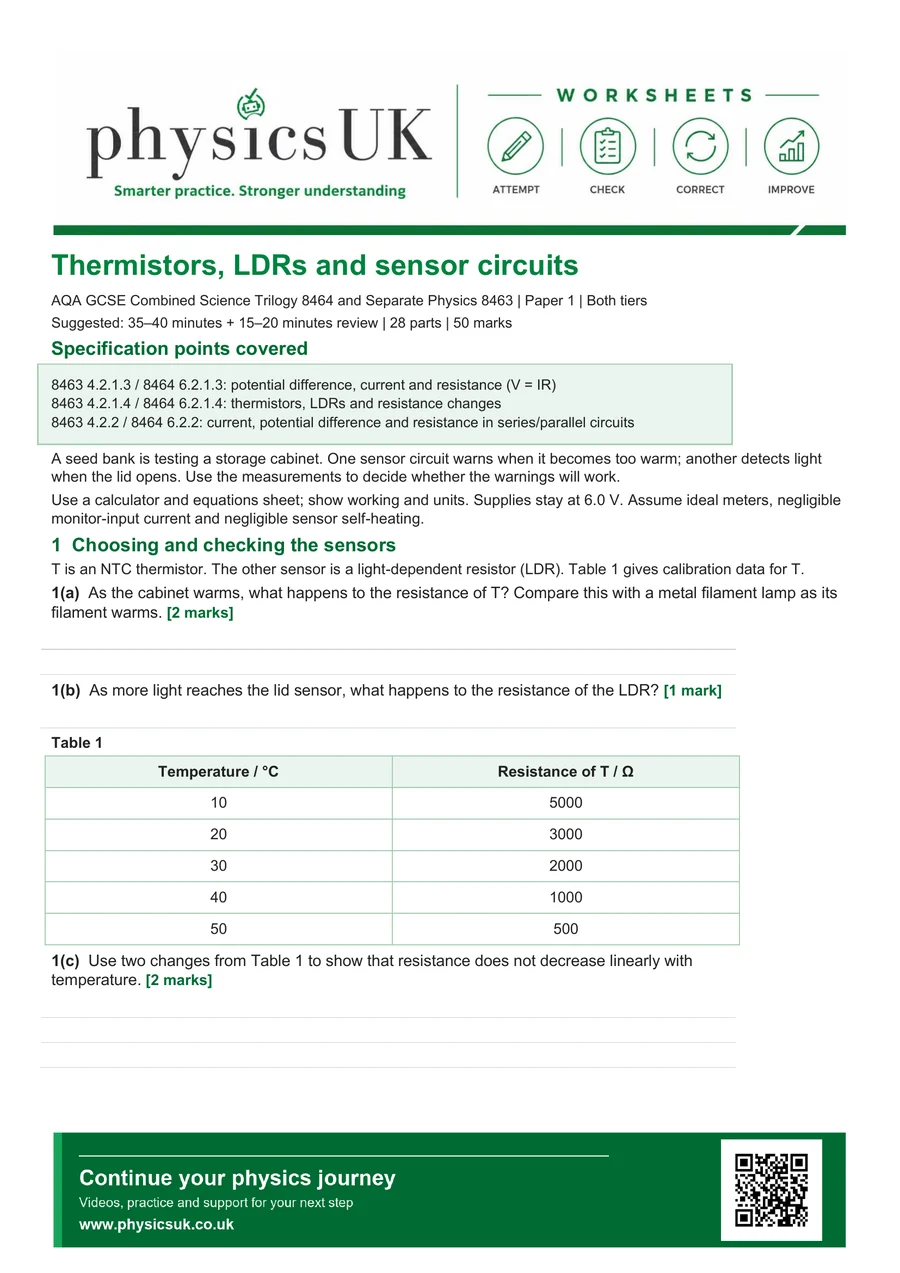
The worksheet contains 6 pages of printable questions. A separate 6-page solutions PDF makes it easy to mark, review or share answers after the activity.
- NTC and LDR resistance trends
- Contrast with metal filament resistance
- Non-linear resistance-temperature data
- Resistance from measured voltage and current
- Milliamp conversions
- Repeated series current and voltage calculations
- Temperature warning and light-sensitive lid alarm thresholds
- Open-circuit and short-circuit faults
- Dust and shaded sensor limitations
- Changing the fixed resistor
- Parallel branch current and supply current
- Precise linked circuit explanations
About this activity
Seed-storage cabinet temperature warning and light-sensitive lid alarm, with data, explicit trigger thresholds and faults.
Before you start
After teaching component resistance changes, V=IR, milliamp conversions and series/parallel current and voltage rules.
A question from the worksheet
Question5(d), pupil page6
A6.0V series light-sensor circuit uses a1000Ω fixed resistor and a1000Ω bright LDR. An alarm activates if LDR voltage is2.5V or less. Does it activate?
Show the answer
Total resistance2000Ω gives0.0030A. LDR voltage3.0V is above2.5V, so no alarm. Equal series resistances sharing the supply equally is also valid.
Common error: Assuming an open lid always triggers the alarm, or assuming voltage across any component must increase when circuit current increases.
Revise the physics
Specification fit
AQA GCSE Physics Worksheets
8463 and 8464 · 4.2.1.3, 4.2.1.4, 4.2.2, 6.2.1.3, 6.2.1.4, 6.2.2
- 8463: 4.2.1.3, 4.2.1.4, 4.2.2
- 8464: 6.2.1.3, 6.2.1.4, 6.2.2
Choose the correct pathway: Combined Trilogy 8464 and Separate Physics 8463, both tiers. Supplied trigger rules and GCSE circuit reasoning; no A-level potential-divider or parallel-resistance formula.
Classroom use
Use the worksheet for class practice, homework, intervention, cover work or revision. Keep the PhysicsUK attribution intact when sharing copies with pupils.