
Free worksheet and solutions · AQA GCSE · 8463
AQA GCSE Physics Static Electricity and Electric Fields Worksheet
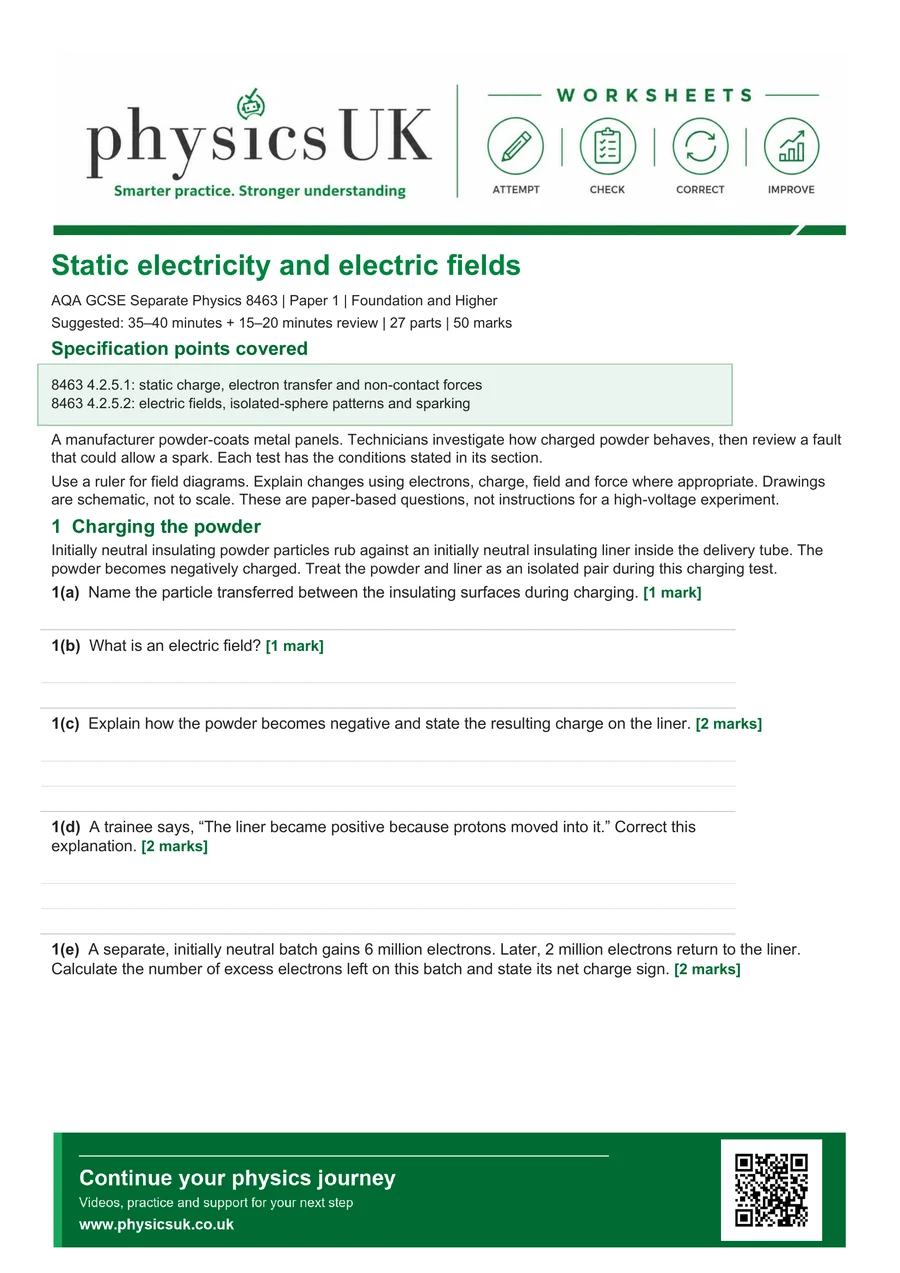
AQA GCSE Separate Physics static electricity worksheet with answers. Apply electron transfer, charging and field ideas to practical electrostatic problems.
What is covered
Questions and skills covered
The worksheet contains 6 pages of printable questions. A separate 6-page solutions PDF makes it easy to mark, review or share answers after the activity.
- Electron transfer and charge conservation
- Excess electrons and charge sign
- Non-contact attraction and repulsion
- Powder-particle spreading
- Repulsion as evidence of like charges
- Why attraction alone does not establish opposite net charges
- Neutral-metal electron redistribution
- Isolated positive and negative sphere fields
- Field-arrow direction and force on positive/negative charges
- Field and force weakening with distance
- Air ionisation and sparking
- Spark-gap data interpretation and interpolation
- Earthing positive and negative conductors
- Floating wire versus earth connection
- Charge-buildup ignition-hazard explanation
About this activity
Powder-coating technicians predict forces, interpret charge evidence, map isolated-sphere fields, analyse spark-gap data and explain a production earthing fault.
Before you start
After teaching electron/proton charge, rubbing and static charge, like/unlike forces and the qualitative electric-field model. Earth and neutral-metal electron-motion models are supplied in the questions.
A question from the worksheet
Questions3(a)–3(b), pupil page3
A negative probe repels X but attracts Y without contact or a spark. What can be concluded about the charge of each object?
Show the answer
X has a negative net charge: like charges repel. Y could be positive or neutral; electron redistribution in a neutral object can also produce attraction.
Common error: Treating attraction as proof that both objects have opposite net charges, or saying protons transfer during rubbing.
Revise the physics
Specification fit
AQA GCSE Physics Worksheets
8463 · 4.2.5.1, 4.2.5.2
- 8463: 4.2.5.1, 4.2.5.2
Choose the correct pathway: Separate Physics 8463 only, both tiers, Paper 1. Qualitative charging and fields; no Coulomb law or field-strength equations. Conductor redistribution and earthing are scaffolded.
Classroom use
Use the worksheet for class practice, homework, intervention, cover work or revision. Keep the PhysicsUK attribution intact when sharing copies with pupils.