
Free worksheet and solutions · AQA GCSE · 8463
AQA GCSE Physics Radiation in Medicine Uses Risks and Half Life Worksheet
AQA GCSE Separate Physics medical-radiation worksheet with answers. Evaluate tracers, treatment, half-life choices and precautions using fictional evidence.
What is covered
Questions and skills covered
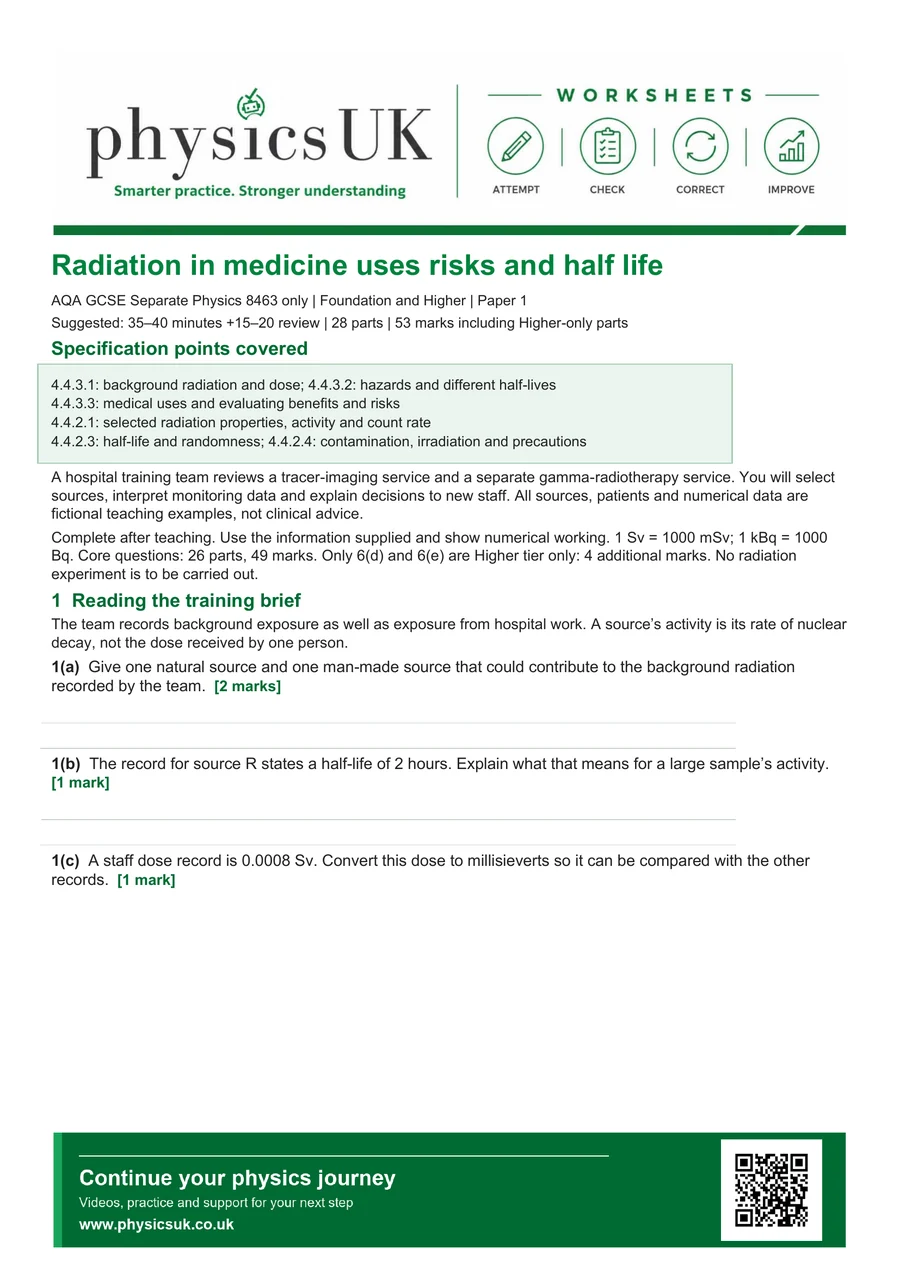
The worksheet contains 6 pages of printable questions. A separate 6-page solutions PDF makes it easy to mark, review or share answers after the activity.
- Natural and man-made background sources
- Dose conversion:1 Sv = 1000 mSv
- Activity conversion:1 kBq = 1000 Bq
- Gamma penetration linked to external detection of an internal tracer
- Alpha range and local ionisation limit this particular tracer use
- Use preliminary signal evidence and half-life together; no universal half-life-only hazard ranking
- Long useful lifetime can benefit an external sealed therapy source
- Irradiation alone does not make a patient radioactive
- Tracer continues decaying when detector removed
- Unwanted radioactive-liquid spill is contamination
- Gloves reduce radioactive-material transfer, not gamma irradiation
- Shielding, distance, time and careful treatment targeting
- Observed R activities640, 320, 160, 80, 40 kBq at 0, 2, 4, 6, 8 h
- Half-life2h and random individual decay
- 160 kBq passes the 150 kBq minimum; 80 kBq fails
- Corrected count rate(546 − 66) / 60 = 8.0 counts/s, not automatically Bq
- Annual occupational contributions0.40/1.20 mSv; 1.8 mSv background gives 3.0 mSv total for imaging worker
- Risk is not certain harm or zero risk
- Location/altitude and occupation can affect exposure
- Peer review checks methods and evidence
- Scaffolded six-mark-style benefits, hazards and justified precautions
- Higher-only: remaining 1/8 versus decline 7/8
- Higher-only: transport 6 h = 3 half-lives; minimum preparation activity 6.0 × 10⁵ Bq
About this activity
Select sources and justify medical applications using radiation properties, adequate useful lifetime and evidence about exposure.
Before you start
Alpha/gamma penetration and ionisation, activity/count rate, half-life, decimal/standard-form arithmetic and unit conversion. HT additions require repeated-halving fractions.
A question from the worksheet
Question2(a), pupil page2
The tracer test takes4h. R emits gamma with a2h half-life and remains detectable throughout; S emits gamma with a60day half-life. Which better fits the short investigation?
Show the answer
R: gamma can escape to the external detector, its signal lasts for the test and its activity falls more quickly afterwards than S’s.
Common error: Choosing only by half-life, claiming gamma is harmless or treating the detector as the cause of radioactive decay.
Revise the physics
Specification fit
AQA GCSE Physics Worksheets
8463 · 4.4.2.1, 4.4.2.3, 4.4.2.4, 4.4.3.1, 4.4.3.2, 4.4.3.3
- 8463: 4.4.2.1, 4.4.2.3, 4.4.2.4, 4.4.3.1, 4.4.3.2, 4.4.3.3
Choose the correct pathway: Separate Physics 8463 only, Paper 1. Foundation omits Higher-only 6(d) and 6(e); the remaining core is both-tier. Fictional training data, not clinical guidance.
Classroom use
Use the worksheet for class practice, homework, intervention, cover work or revision. Keep the PhysicsUK attribution intact when sharing copies with pupils.