
Free worksheet and solutions · AQA GCSE · 8463 / 8464
AQA GCSE Physics Alpha Beta Gamma Penetration and Shielding Worksheet
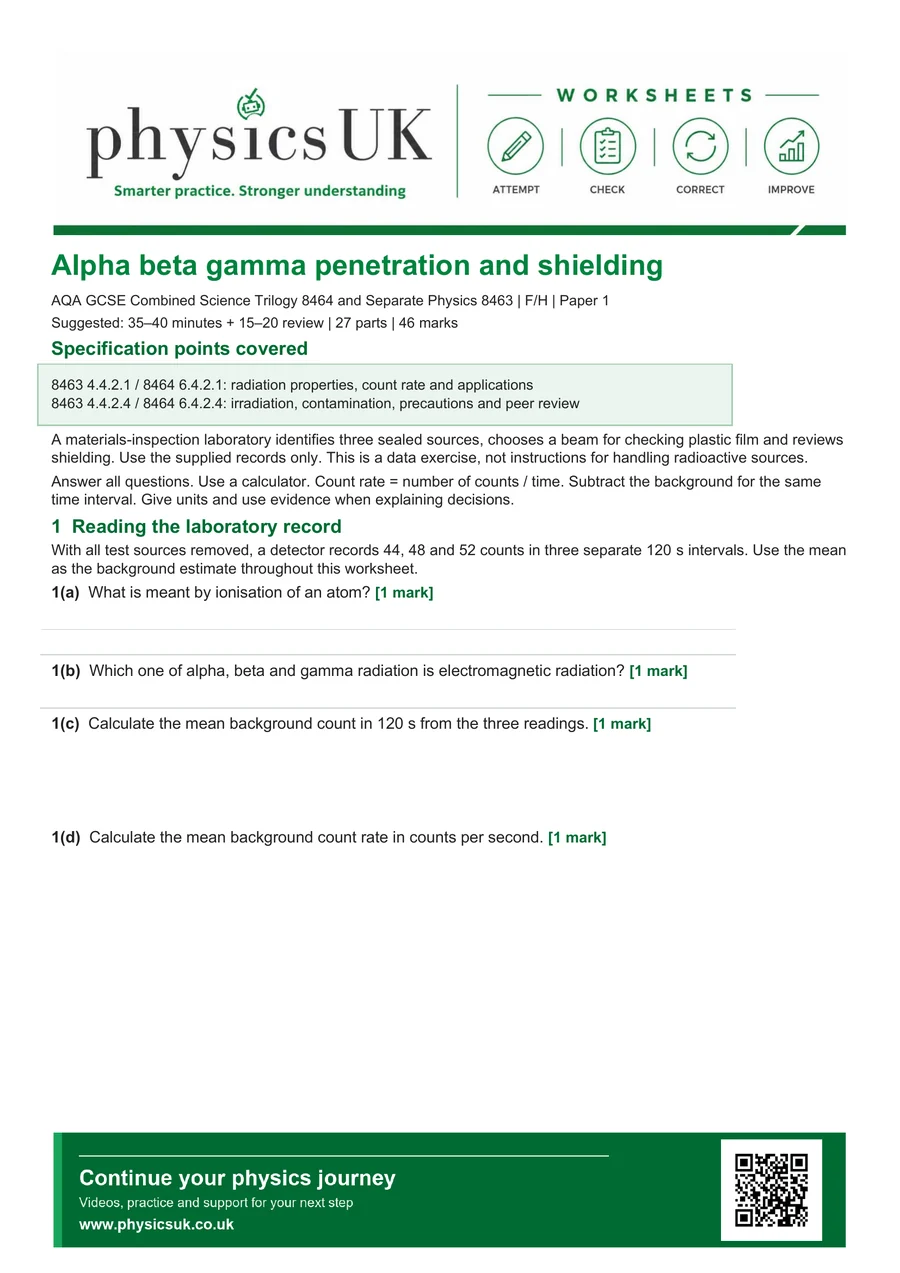
AQA GCSE alpha, beta and gamma worksheet with answers. Interpret penetration and detector evidence, correct count rates and justify shielding choices.
What is covered
Questions and skills covered
The worksheet contains 6 pages of printable questions. A separate 6-page solutions PDF makes it easy to mark, review or share answers after the activity.
- Background mean and matched-time count-rate correction
- Count rate versus source activity
- Source-absorber-detector arrangement
- Controlled time and geometry
- Alpha range in air
- Paper/aluminium/lead inference
- Alpha, beta and gamma identification from supplied detector records
- Plastic-film thickness-gauge application
- Sensitivity from supplied data
- Penetration versus ionising power
- Gamma attenuation rather than complete stopping
- Smallest tested shield meeting a supplied criterion
- Random counting fluctuations
- Improving a mean count-rate estimate
- Irradiation versus contamination
- Intact sealed source versus deposited radioactive material
- Internal alpha hazard
- Remote shielded control and source shutter
- Peer review
About this activity
A materials-inspection laboratory identifies sealed sources, chooses a plastic-film gauge and reviews lead shielding and contamination hazards using supplied records.
Before you start
After teaching radiation properties and contamination/irradiation. Mean calculation and count/time arithmetic; all background readings supplied.
A question from the worksheet
Question5(a–c), pupil page5
A gamma source records1008counts behind10mmlead and288counts behind20mmlead in120s; background48counts. Which tested shield meets a corrected-rate maximum of5counts/s?
Show the answer
10mm gives(1008−48)/120=8counts/s and fails;20mm gives(288−48)/120=2counts/s and meets the test criterion. The gamma signal remains above background, so lead has not stopped all radiation.
Common error: Treating a lower detector reading as a lower decay rate, or confusing highly penetrating radiation with strongly ionising radiation.
Revise the physics
Specification fit
AQA GCSE Physics Worksheets
8463 and 8464 · 4.4.2.1, 4.4.2.4, 6.4.2.1, 6.4.2.4
- 8463: 4.4.2.1, 4.4.2.4
- 8464: 6.4.2.1, 6.4.2.4
Choose the correct pathway: Combined Trilogy 8464 and Separate Physics 8463, both tiers. Supplied detector-background data only; no Separate-only background-source recall or practical handling of sources.
Classroom use
Use the worksheet for class practice, homework, intervention, cover work or revision. Keep the PhysicsUK attribution intact when sharing copies with pupils.