
Free worksheet and solutions · AQA GCSE · 8463 / 8464
AQA GCSE Physics Paper 2 Multi Step Calculation Practice Worksheet
AQA GCSE Physics Paper 2 calculation worksheet with answers. Combine force, motion, energy and wave evidence in an applied engineering scenario.
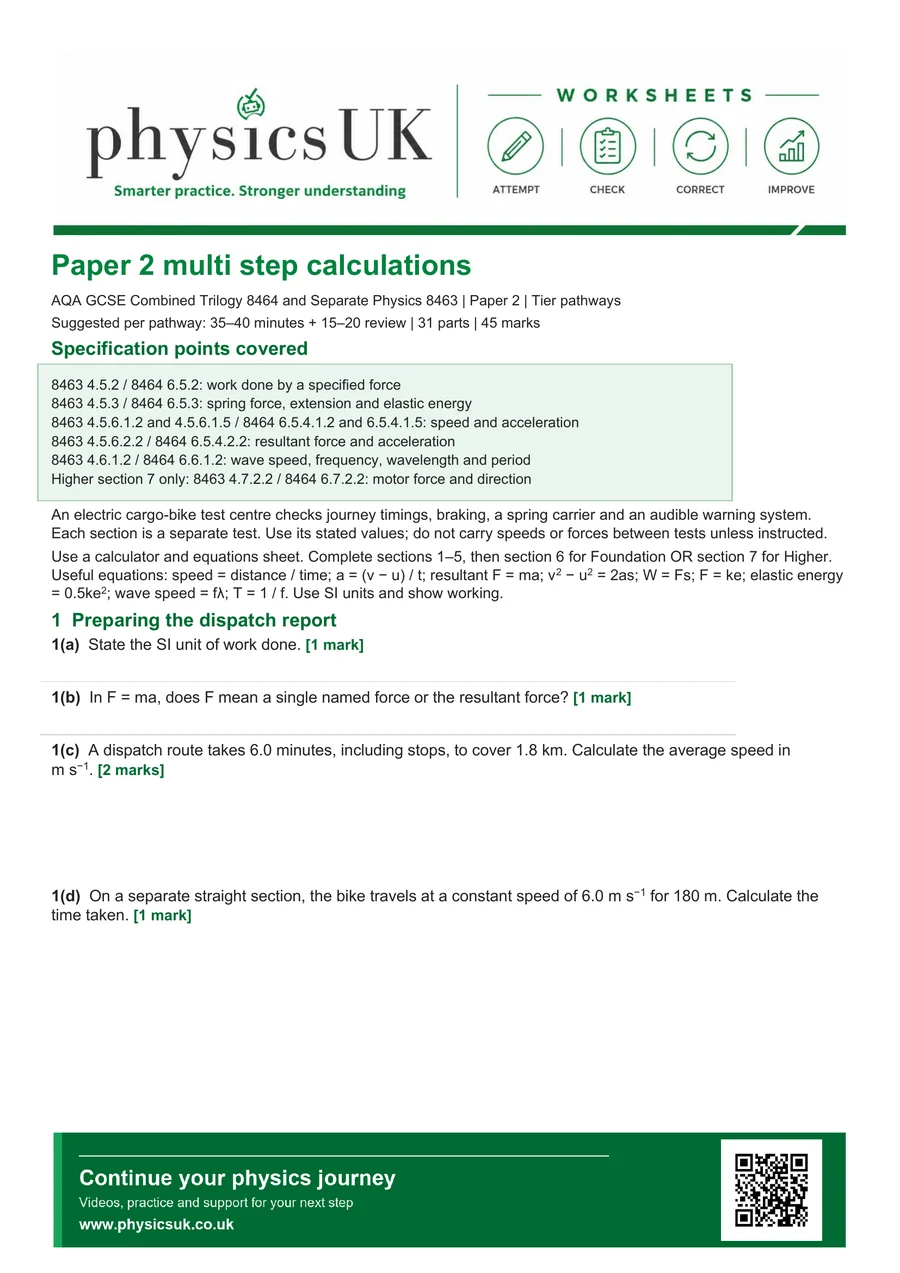
What is covered
Questions and skills covered
The worksheet contains 7 pages of printable questions. A separate 7-page solutions PDF makes it easy to mark, review or share answers after the activity.
- Multi-step equation selection with SI conversions
- Average speed including stops
- Constant-speed distance and time
- Exact velocity–time data interpretation
- Signed acceleration without reversed motion
- Resultant versus driving or resistive force
- Uniform-braking force, time and distance
- GCSE v²−u²=2as calculation
- Work done by a named force versus net work
- Extension as loaded minus unloaded length
- Spring force and spring constant
- Elastic energy and squared-extension comparisons
- Force-limit decisions
- Sound wavelength and frequency
- Period and propagation time
- Receiver wavelength compatibility
- Foundation route: loaded-bike acceleration and inclusive journey deadline
- Higher route: F=B I ℓ and current/field/force direction
- Higher route: linked magnetic force, resultant force, acceleration and speed
- Higher route: effect of a fixed opposing force when current doubles
About this activity
An electric cargo-bike test centre checks motion data, braking, carrier-spring limits, a warning receiver and a tier-specific final test. Pupils must choose the relevant force and equation, link steps and justify whether test criteria are met.
Before you start
After teaching the selected Paper2 equations and basic SI conversions. Higher pupils additionally need the motor effect and Fleming’s left-hand rule. Use the equation sheet; no advanced SUVAT set is assumed.
A question from the worksheet
Question3(e–f), pupil page3
A300N driving force and60N resistance act over20m. Is(300−60)×20=4800J the work done by the driving force?
Show the answer
No. Driving-force work=300×20=6000J; work against resistance=60×20=1200J.4800J is the net work by the horizontal forces.
Common error: Using the resultant for the work of a named force, confusing negative acceleration with reversed velocity, or squaring a spring extension before converting centimetres to metres.
Specification fit
AQA GCSE Physics Worksheets
8463 and 8464 · 4.5.2, 4.5.3, 4.5.6.1.2, 4.5.6.1.5, 4.5.6.2.2, 4.6.1.2, 4.7.2.2, 6.5.2, 6.5.3, 6.5.4.1.2, 6.5.4.1.5, 6.5.4.2.2, 6.6.1.2, 6.7.2.2
- 8463: 4.5.2, 4.5.3, 4.5.6.1.2, 4.5.6.1.5, 4.5.6.2.2, 4.6.1.2, 4.7.2.2
- 8464: 6.5.2, 6.5.3, 6.5.4.1.2, 6.5.4.1.5, 6.5.4.2.2, 6.6.1.2, 6.7.2.2
Choose the correct pathway: Combined Trilogy 8464 and Separate Physics 8463. Complete Sections 1–5, then Foundation Section 6 OR Higher Section 7, not both. Motor force and direction are in Higher Section 7.
Classroom use
Use the worksheet for class practice, homework, intervention, cover work or revision. Keep the PhysicsUK attribution intact when sharing copies with pupils.