
Free worksheet and solutions · AQA GCSE · 8463
AQA GCSE Physics Nuclear Fission Fusion and Chain Reactions Worksheet
AQA GCSE Separate Physics fission and fusion worksheet with answers. Interpret chain reactions, evaluate energy claims and build an evidence-based explanation.
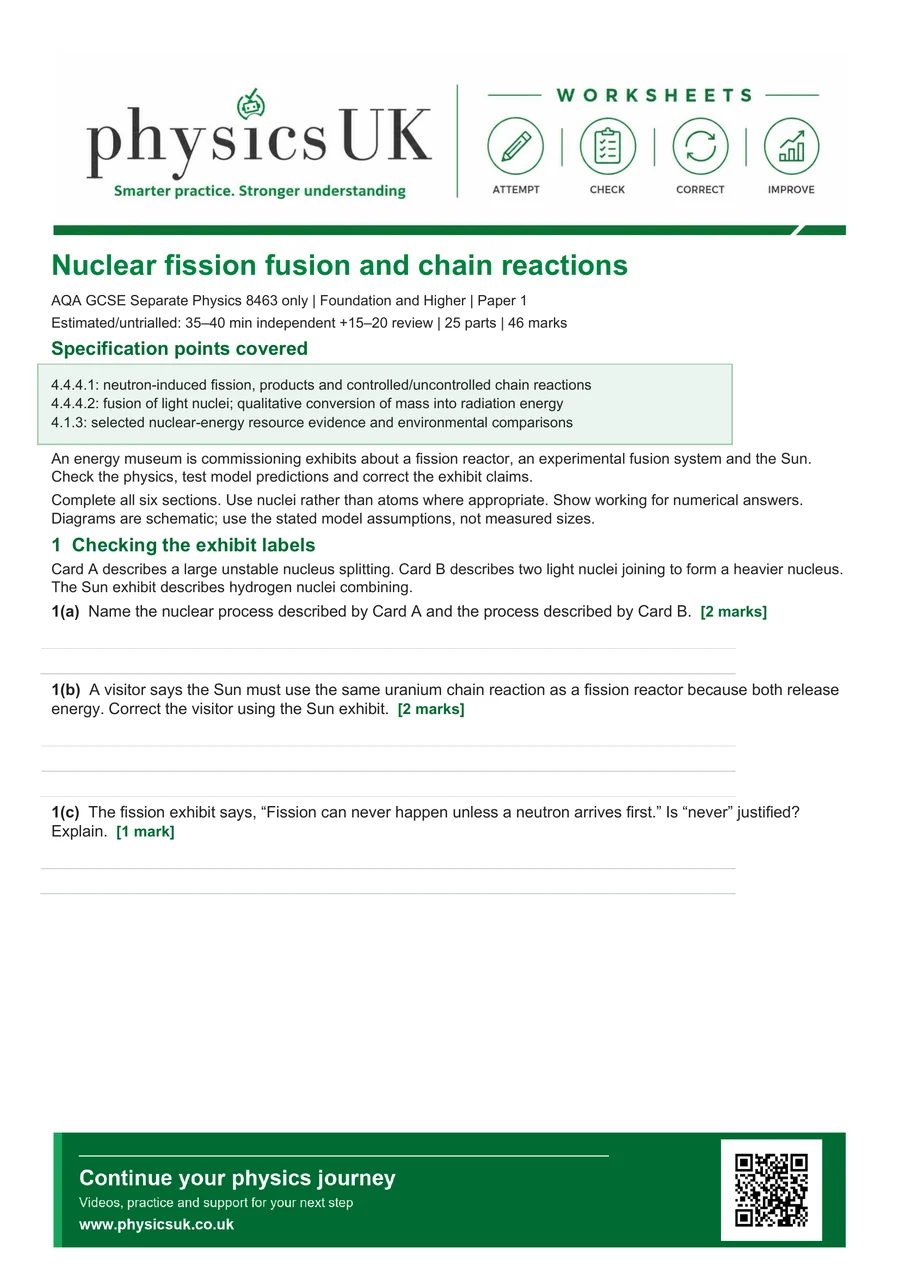
What is covered
Questions and skills covered
The worksheet contains 6 pages of printable questions. A separate 6-page solutions PDF makes it easy to mark, review or share answers after the activity.
- Fission splits a large unstable nucleus; fusion joins two light nuclei to form a heavier nucleus
- Sun fusion distinguished from a uranium fission chain; energy release alone does not identify process
- Usually neutron-induced fission, but rare spontaneous fission is possible
- Interpret before/after particles: incoming neutron, two smaller nuclei, three emitted neutrons in the chosen model and gamma radiation
- Distinguish emitted neutrons from an incoming neutron supposedly breaking into three
- Moving fission products have kinetic energy as well as energy carried by gamma radiation
- Only released neutrons absorbed by fresh fuel and causing further fissions continue the chain
- Absorption/escape losses and one continuing neutron per event; controlled versus uncontrolled energy release
- Ideal next generations: 3 then 9, not cumulative totals; real events need not emit exactly three neutrons
- Control settings X/Y/Z give 100/200/0 next events from 100 initial; steady, growing or stopped chain
- Shutdown does not instantly remove supplied heat/radioactivity hazards
- Qualitative fusion mass-to-radiation energy link; compare combined initial mass, not one incoming nucleus
- Supplied temperature/repulsion facts support why fast nuclei can approach closely enough to fuse
- Fictional fusion pulse: 160 MJ facility input, 120 MJ nuclear output, 40 MJ shortfall; 100 MJ is a nested input
- Nuclear output is not automatically net electricity; test predictions before large-scale commitment
- No CO2 in the fission reaction does not remove waste-management and mining impacts
- Six-mark-style linked explanation with an original best-fit rubric and full example answer
About this activity
Use exact nucleus terminology and causal neutron links; test energy claims at a stated boundary rather than assuming every nuclear event is the same process.
Before you start
After teaching fission, fusion and nuclear-energy resource evidence. Only basic arithmetic for supplied models; no A-level nuclear calculations or detailed reactor engineering.
A question from the worksheet
Question 4(b), pupil page 4
Which setting can maintain a steady chain from 100 starting fissions, and why is Y not steady?
Show the answer
X triggers 100 further fissions, replacing the previous 100. Y triggers 200, so its next generation grows rather than remaining steady.
Common error: Assuming every emitted neutron must cause another fission, or that absorbing any neutrons stops the chain completely.
Revise the physics
Specification fit
AQA GCSE Physics Worksheets
8463 · 4.4.4.1, 4.4.4.2, 4.1.3
- 8463: 4.4.4.1, 4.4.4.2, 4.1.3
Choose the correct pathway: Separate Physics 8463 only, both tiers, Paper 1. Supplied neutron and energy models, not advanced nuclear calculations or claims about commercial fusion performance.
Classroom use
Use the worksheet for class practice, homework, intervention, cover work or revision. Keep the PhysicsUK attribution intact when sharing copies with pupils.