
Free worksheet and solutions · AQA GCSE · 8463 / 8464
AQA GCSE Physics National Grid and Transmission Losses Worksheet
AQA GCSE National Grid worksheet with answers. Compare transmission currents and losses, calculate energy costs and explain why high voltage is used.
What is covered
Questions and skills covered
The worksheet contains 6 pages of printable questions. A separate 6-page solutions PDF makes it easy to mark, review or share answers after the activity.
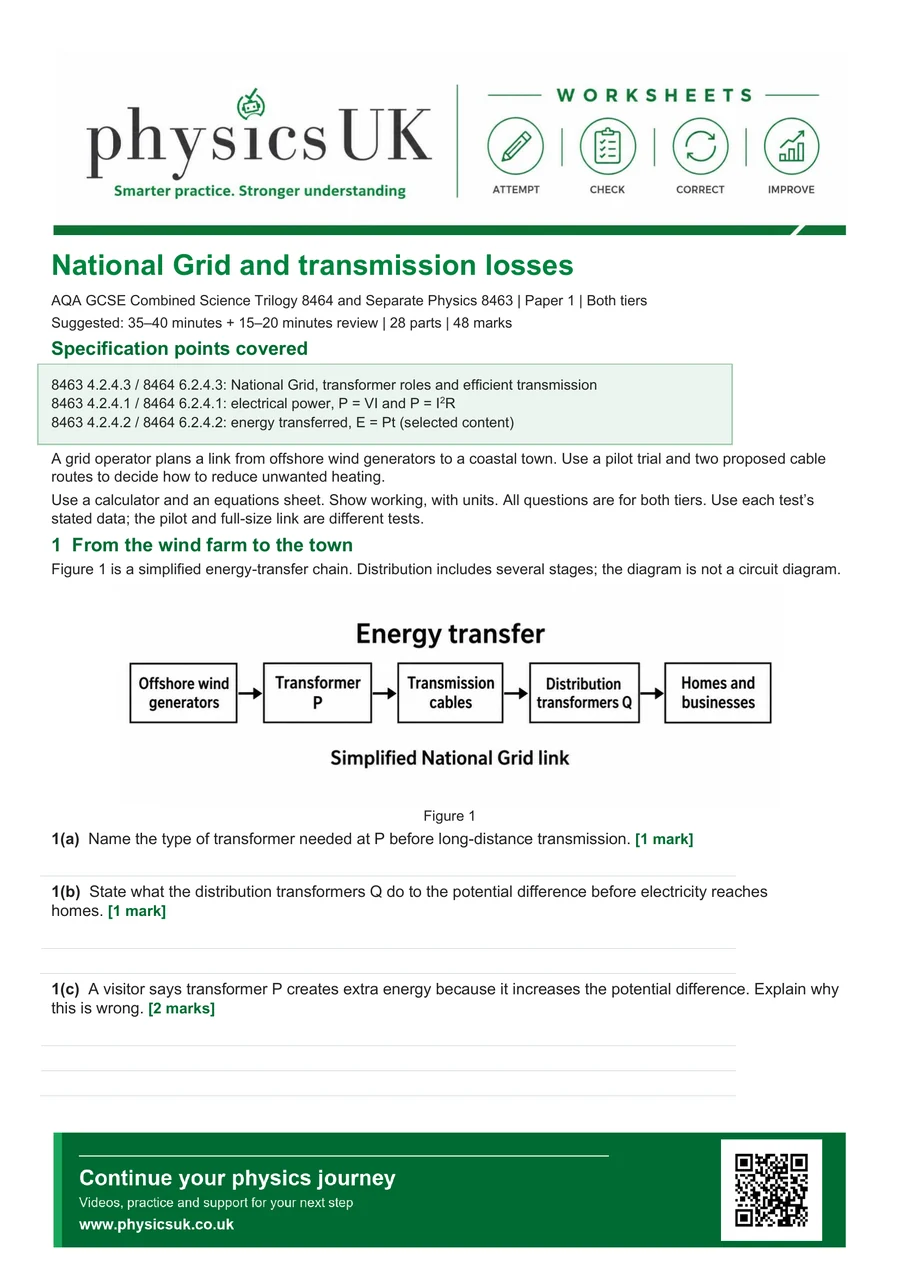
- National Grid generation to consumers
- Step-up and step-down transformer roles
- Current from power and potential difference
- Cable heating with P = I²R
- Squaring current and comparing losses
- Power and energy balances
- Time, power and potential-difference conversions
- Cable-route choice with numerical constraints
- Resistance redesign calculation
- Changing demand and energy dissipated
- Precise efficiency explanations
About this activity
An offshore wind-link operator compares a pilot, transmission settings, cable routes and daily demand.
Before you start
After teaching electrical power, energy, SI prefixes and the roles of National Grid transformers.
A question from the worksheet
Question 3(e), pupil page 3
Why does a higher transmission potential difference improve efficiency at the same input power?
Show the answer
The same power needs a smaller current; this reduces I²R cable heating, so a larger proportion of the input energy reaches consumers.
Common error: Saying that higher potential difference lowers the cable resistance, or that all losses disappear.
Revise the physics
Specification fit
AQA GCSE Physics Worksheets
8463 and 8464 · 4.2.4.3, 4.2.4.1, 4.2.4.2, 6.2.4.3, 6.2.4.1, 6.2.4.2
- 8463: 4.2.4.3, 4.2.4.1, 4.2.4.2
- 8464: 6.2.4.3, 6.2.4.1, 6.2.4.2
Choose the correct pathway: Combined Trilogy 8464 and Separate Physics 8463, both tiers. Shared National Grid and power content only; no transformer turns-ratio, coil-power relation or induction mechanism.
Classroom use
Use the worksheet for class practice, homework, intervention, cover work or revision. Keep the PhysicsUK attribution intact when sharing copies with pupils.