
Free worksheet and solutions · AQA GCSE · 8463 / 8464
AQA GCSE Physics Infrared Absorption Required Practical Worksheet
AQA GCSE infrared practical worksheet with answers. Compare surface heating, read temperature-time graphs, evaluate controls and plan a valid investigation.
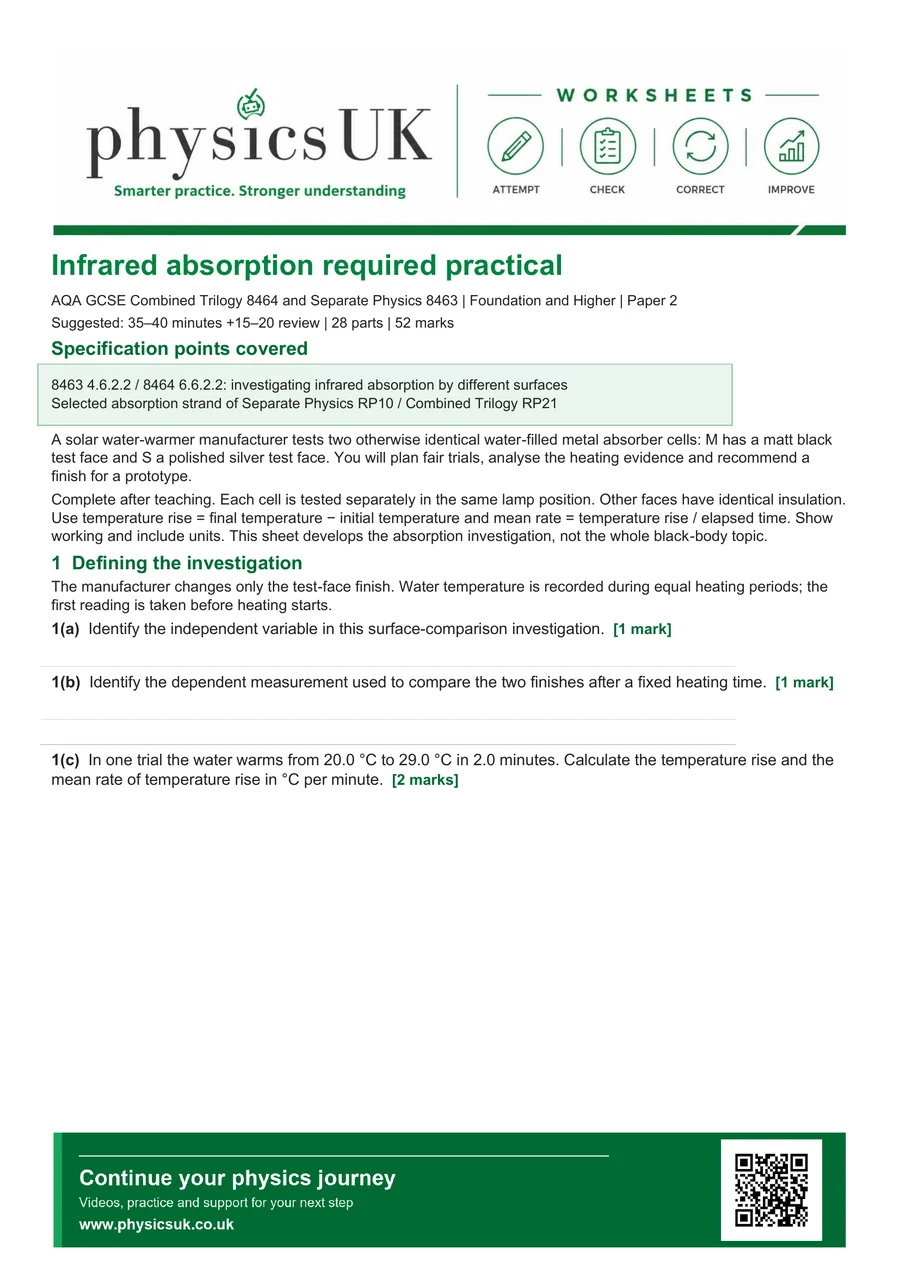
What is covered
Questions and skills covered
The worksheet contains 6 pages of printable questions. A separate 6-page solutions PDF makes it easy to mark, review or share answers after the activity.
- Independent variable is test-face finish; dependent comparison is water temperature rise over fixed time
- Same lamp distance, exposed area, angle, water mass, starting temperature and lamp output
- Cutaway metal cell with probe immersed clear of walls and bottom
- Control explanations credit cause and consequence, not restating given conditions
- M/S temperatures 29/24 degrees Celsius at 2 minutes and 36/28 at 6 minutes
- 6-minute temperature rises 16/8 degrees Celsius
- Early M mean rise rates 4.5 degrees/minute and 0.075 degrees/second
- Late M mean rise rate 1.0 degree/minute
- Slower net heating is not zero absorption
- Repeat means 16.0/8.0 degrees Celsius and ranges 1.0/1.0
- Investigate and document unusual results rather than silently delete them
- Rounding 31.0/31.4 to 31/31 can hide differences
- Repeatability does not prove absence of systematic bias
- Three separately point-marked two-mark method parts scaffold six-mark style
- Linked hot-lamp hazard and precaution
- Unequal lamp distances confound the comparison
- Absorption from a lamp versus emission from a hot surface
- Data-based absorber choice, not an exact absorbed-fraction claim
- Separate controlled cooling test and outdoor prototype validation
About this activity
Use a controlled infrared heating investigation to choose an absorber finish, while distinguishing what the evidence does and does not establish.
Before you start
Heating and infrared absorption, temperature differences, arithmetic means, range, unit conversion and reading simple Cartesian graphs. No black-body equations or numerical heat-capacity calculation needed.
A question from the worksheet
Questions 3(b) and 6(c), pupil pages 3 and 6
Both cells start at 20 degrees Celsius. After 6 minutes, M is 36 and S is 28. Does this prove M absorbs exactly twice the fraction of incident radiation?
Show the answer
The rises are 16 and 8 degrees Celsius. That is twice the net temperature rise, not a direct measure of absorbed fraction: energy can also leave the cells while heating.
Common error: Using final temperature instead of temperature rise, or treating a heating-rate comparison as an exact absorbed-energy measurement.
Revise the physics
Specification fit
AQA GCSE Physics Worksheets
8463 and 8464 · 4.6.2.2, 6.6.2.2
- 8463: 4.6.2.2
- 8464: 6.6.2.2
Choose the correct pathway: Combined Trilogy 8464 and Separate Physics 8463, both tiers. Selected RP10/RP21 absorption work. A net-heating comparison does not directly measure all absorbed radiation.
Classroom use
Use the worksheet for class practice, homework, intervention, cover work or revision. Keep the PhysicsUK attribution intact when sharing copies with pupils.