
Free worksheet and solutions · AQA GCSE · 8463 / 8464
AQA GCSE Physics I V Graphs Resistance and Component Choice Worksheet
AQA GCSE I–V graphs worksheet with answers. Read resistor, lamp and diode graphs, calculate resistance and choose components for operating conditions.
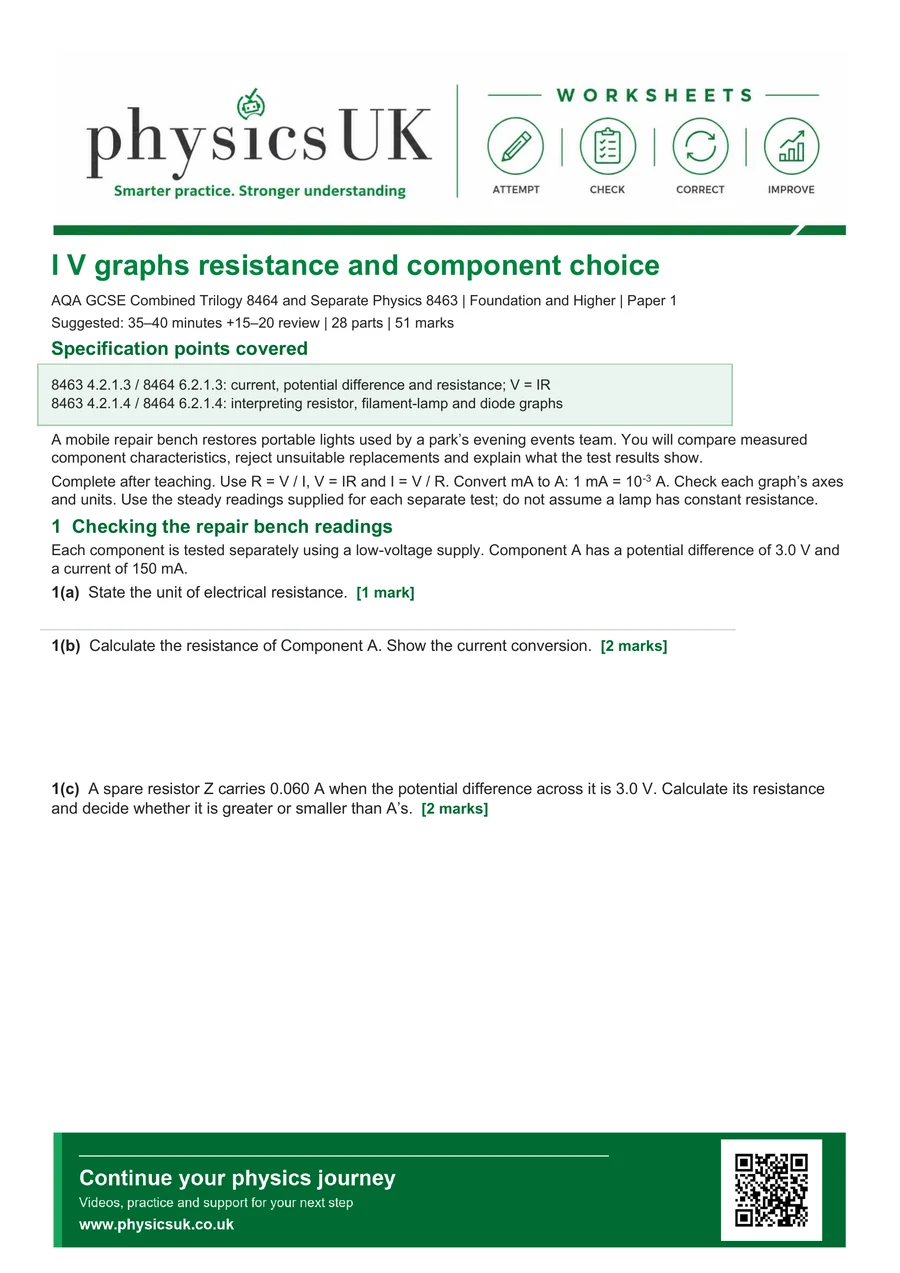
What is covered
Questions and skills covered
The worksheet contains 6 pages of printable questions. A separate 6-page solutions PDF makes it easy to mark, review or share answers after the activity.
- mA-to-A conversion and V=IR
- A resistance 20 ohm and spare Z 50 ohm
- Straight line through origin at constant temperature for ohmic behaviour
- Potential difference vertically versus current vertically
- Reversed current sign does not mean negative resistance
- Lamp steady current 0.40/0.50 A at 3.0/6.0 V
- Lamp resistance increases from 7.5 to 12 ohm as filament temperature rises
- Diode 20/80 mA at 0.60/0.80 V to stated precision
- Diode forward resistance decreases from 30 to 10 ohm
- Negligible reverse current indicates very high resistance, not zero
- Current-limit decisions at two operating points
- Directionality and proportional-response choices
- Different nonlinear components need not change resistance in the same direction
- I-against-V straight-line gradient 0.050 A/V is not 20 ohm
- No defined resistance from 0/0
- Repeat mean 0.40 A gives 7.5 ohm
- Constant temperature and several operating points needed to test proportionality
About this activity
Choose suitable replacement components using measured graphs, rather than assuming all components have constant resistance.
Before you start
Current, potential difference, V=IR, decimal unit conversion and reading Cartesian graphs. No A-level circuit theory is needed.
A question from the worksheet
Questions 4(a)–4(c), pupil page 4
A diode takes 20 mA at 0.60 V and 80 mA at 0.80 V. Does its resistance stay constant?
Show the answer
No. Convert to 0.020 A and 0.080 A; R=V/I gives 30 ohm and 10 ohm at the two operating points.
Common error: Using milliamperes directly in V/I, assuming every nonlinear component gets more resistive, or treating the nonlinear tangent gradient as operating-point resistance.
Revise the physics
Specification fit
AQA GCSE Physics Worksheets
8463 and 8464 · 4.2.1.3, 4.2.1.4, 6.2.1.3, 6.2.1.4
- 8463: 4.2.1.3, 4.2.1.4
- 8464: 6.2.1.3, 6.2.1.4
Choose the correct pathway: Combined Trilogy 8464 and Separate Physics 8463, both tiers. Check which quantity is on each axis; a targeted graph/application follow-up, not a complete I–V practical pack.
Classroom use
Use the worksheet for class practice, homework, intervention, cover work or revision. Keep the PhysicsUK attribution intact when sharing copies with pupils.