
Free worksheet and solutions · AQA GCSE · 8463
AQA GCSE Physics Gas Pressure Volume and Boyle Law Worksheet
AQA GCSE Separate Physics gas pressure worksheet with answers. Apply particle explanations and Boyle law, interpret evidence and compare compression tests.
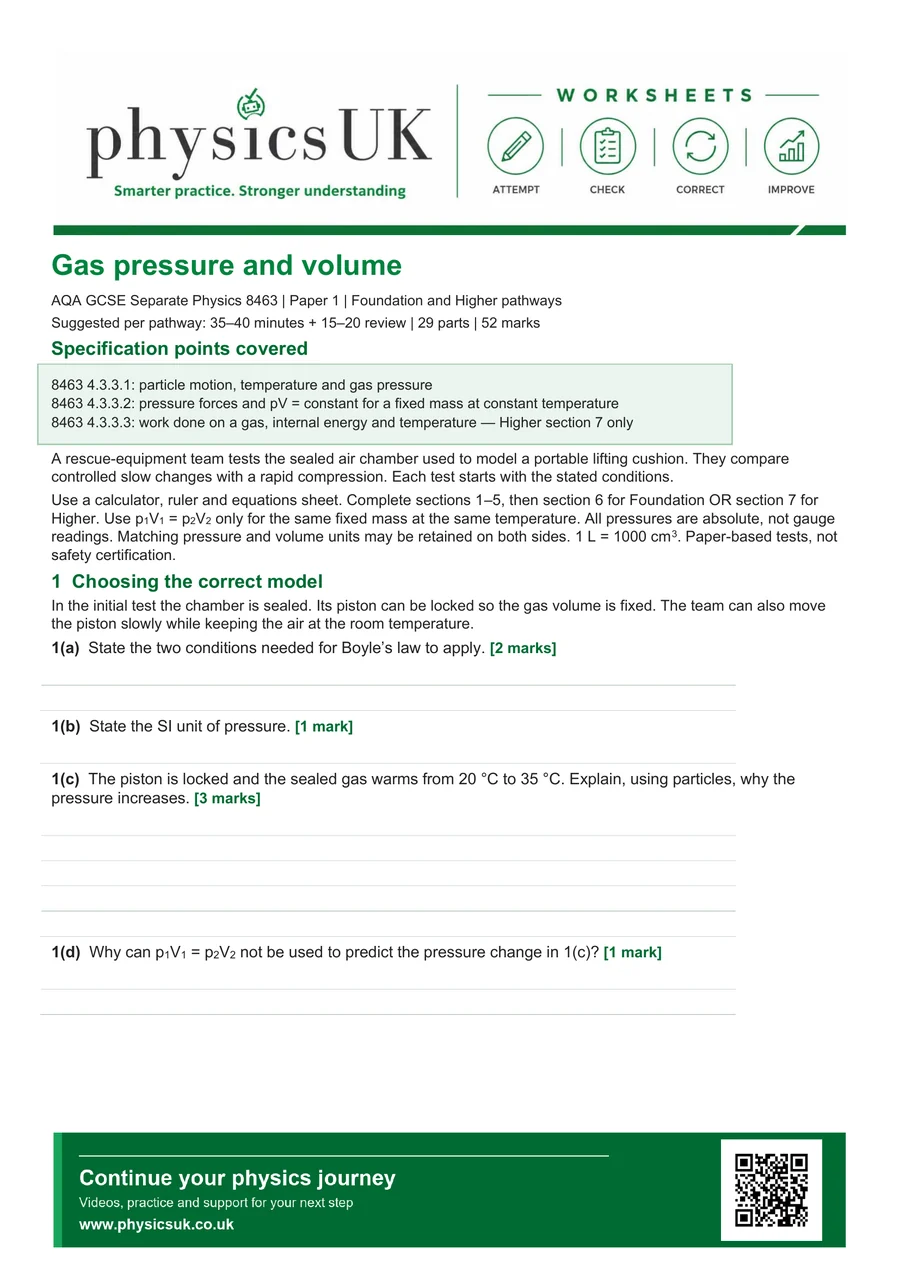
What is covered
Questions and skills covered
The worksheet contains 7 pages of printable questions. A separate 7-page solutions PDF makes it easy to mark, review or share answers after the activity.
- Fixed mass and constant-temperature conditions
- SI pressure unit and consistent units
- Wall collisions and average force per unit area
- Pressure force perpendicular to a surface
- Slow compression without increased mean molecular speed
- Molecular size versus separation
- Pressure and volume calculations with changing unknowns
- Litres to cubic centimetres
- SI pV product
- Pressure-limit decisions
- Inverse proportionality from graph evidence
- Pressure–volume graph readings and off-scale prediction
- Constant-product checks and leaky-valve evidence
- Checking temperature control and airtightness
- Why averaging cannot repair a changed gas mass
- Higher: work increasing internal energy and temperature
- Higher: rapid-compression comparison invalid at changed temperature
- Common physics in Higher route: cooling at fixed volume and equal-temperature endpoint comparison
About this activity
A rescue-equipment team uses a sealed piston rig to model a lifting-cushion chamber, check pressure limits and judge whether the gas conditions justify Boyle-law calculations.
Before you start
After teaching gas-particle motion, pressure as force per area and pV=constant. Use supplied equations, basic rearrangement and1L=1000cm³. Higher route additionally assumes work/internal energy teaching.
A question from the worksheet
Question3(f), pupil page3
A sealed chamber starts at100kPa and900cm³. At constant temperature it is compressed to180cm³. Does it meet a450kPa pressure limit?
Show the answer
p=100×900/180=500kPa. It exceeds450kPa, so it fails this stated pressure limit; that decision is not a full safety assessment.
Common error: Treating pressure and volume as directly proportional, mixing litres/cm³, or applying pV=constant to the warmer rapid-compression stage.
Revise the physics
Specification fit
AQA GCSE Physics Worksheets
8463 · 4.3.3.1, 4.3.3.2, 4.3.3.3
- 8463: 4.3.3.1, 4.3.3.2, 4.3.3.3
Choose the correct pathway: Separate Physics 8463 only. Complete common Sections 1–5, then Foundation Section 6 OR Higher Section 7, not both. Work-on-gas explanations are in Higher Section 7.
Classroom use
Use the worksheet for class practice, homework, intervention, cover work or revision. Keep the PhysicsUK attribution intact when sharing copies with pupils.