
Free worksheet and solutions · AQA GCSE · 8463 / 8464
AQA GCSE Physics Particle Model, Changes of State and Specific Latent Heat Worksheet
Practise GCSE specific latent heat, particle models and heating curves with an applied cooling-pack scenario. Download the AQA worksheet PDF and worked answers.
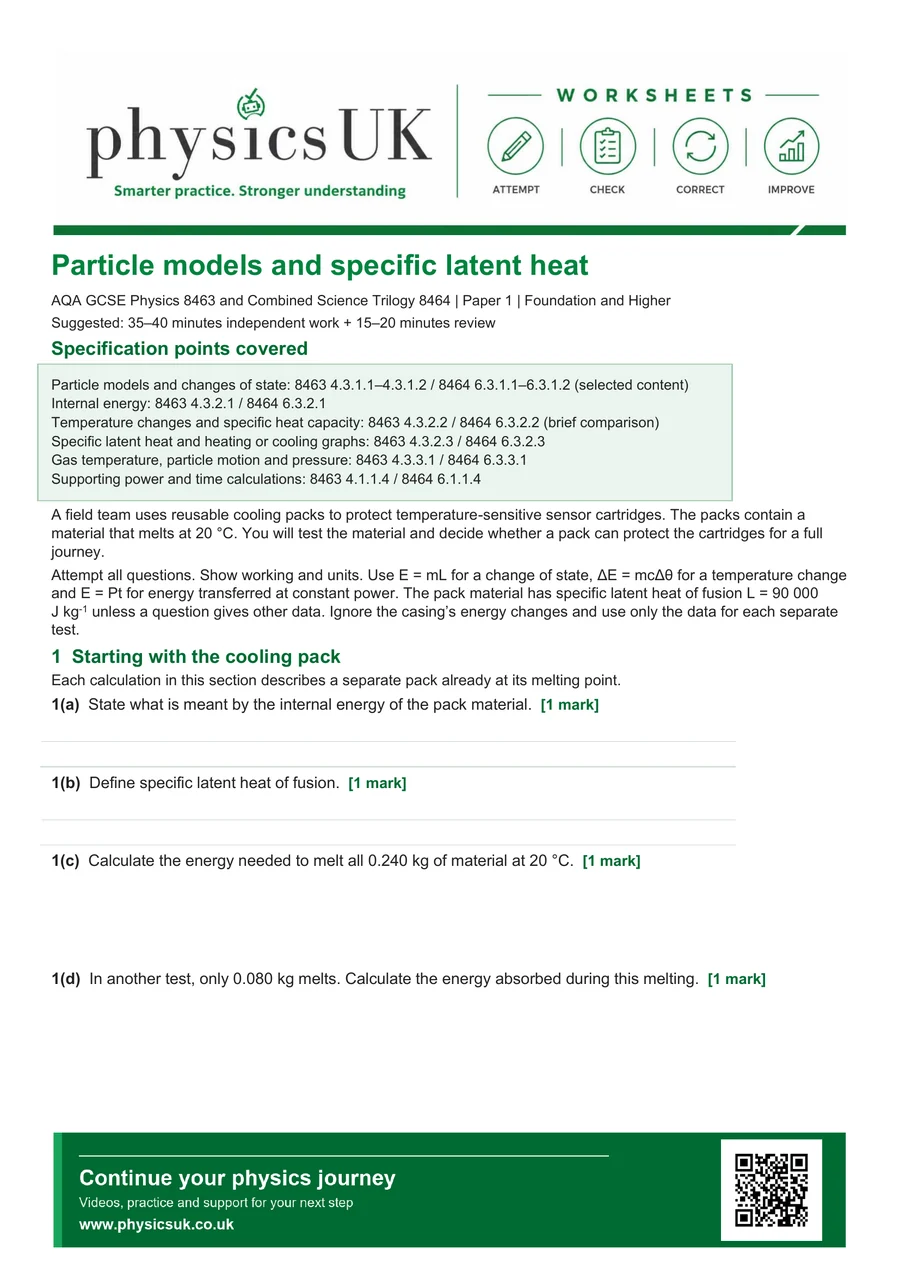
What is covered
Questions and skills covered
The worksheet contains 7 pages of printable questions. A separate 7-page solutions PDF makes it easy to mark, review or share answers after the activity.
- Particle Model, Changes of State and Specific Latent Heat
- Both tiers; selected particle model and latent heat, not a complete SHC practical or the Separate-only pV law.
- A field team tests a reusable phase-change pack for temperature-sensitive sensor cartridges. Pupils compare particle arrangements and motion, explain mass conservation and physical changes, practise E=mL with conversions and unknown mass or latent heat, interpret an accurately checked heating curve, distinguish SHC from latent heat, and decide whether a pack can protect equipment for an eight-hour journey. Gas questions connect warming to molecular collisions and pressure.
About this activity
A field team tests a reusable phase-change pack for temperature-sensitive sensor cartridges. Pupils compare particle arrangements and motion, explain mass conservation and physical changes, practise E=mL with conversions and unknown mass or latent heat, interpret an accurately checked heating curve, distinguish SHC from latent heat, and decide whether a pack can protect equipment for an eight-hour journey. Gas questions connect warming to molecular collisions and pressure.
Before you start
Both tiers; selected particle model and latent heat, not a complete SHC practical or the Separate-only pV law.
A question from the worksheet
Original question from this worksheet
A 0.240 kg solid pack at its melting point absorbs energy at 0.60 W for 8.0 hours. Its specific latent heat of fusion is 90 000 J/kg. How much solid remains, and does it meet a requirement that some solid remains at arrival?
Show the answer
Time = 28 800 s; energy = 0.60 × 28 800 = 17 280 J. Mass melted = 17 280 / 90 000 = 0.192 kg. Solid remaining = 0.240 − 0.192 = 0.048 kg, so the pack passes. Melting absorbs energy without a temperature rise while solid and liquid coexist.
Common error: Check units, the stated model and the course/tier labels before choosing the physics.
Specification fit
AQA GCSE Physics Worksheets
8463 and 8464 · 4.3.1.1, 4.3.1.2, 4.3.2.1, 4.3.2.2, 4.3.2.3, 4.3.3.1, 4.1.1.4, 6.3.1.1, 6.3.1.2, 6.3.2.1, 6.3.2.2, 6.3.2.3, 6.3.3.1, 6.1.1.4
- 8463: 4.3.1.1, 4.3.1.2, 4.3.2.1, 4.3.2.2, 4.3.2.3, 4.3.3.1, 4.1.1.4
- 8464: 6.3.1.1, 6.3.1.2, 6.3.2.1, 6.3.2.2, 6.3.2.3, 6.3.3.1, 6.1.1.4
Choose the correct pathway: Both tiers; selected particle model and latent heat, not a complete SHC practical or the Separate-only pV law.
Classroom use
Use the worksheet for class practice, homework, intervention, cover work or revision. Keep the PhysicsUK attribution intact when sharing copies with pupils.