
What makes the colours in a firework?
At a Bonfire Night display, a shell can open into red, green or blue points of light. The colour-producing material matters. Heating different substances can produce different patterns of emitted wavelengths, which our eyes register as different colours.
The Royal Society of Chemistry explains how the hot material produces light. For physics pupils, the useful step is to connect that observation to energy transfer inside atoms and molecules. A coloured flash is evidence of a microscopic process you cannot see directly.
Fireworks also produce light from very hot particles. That is why a whole display cannot be explained as one pure atomic emission line. Different processes contribute to the colours, sparks and bright white light.
From a hot atom to a coloured flash
An atom has allowed electron energy levels. An electron can gain energy in a collision and move to a higher level. We call the atom excited. This does not mean the electron can sit at any energy you choose.
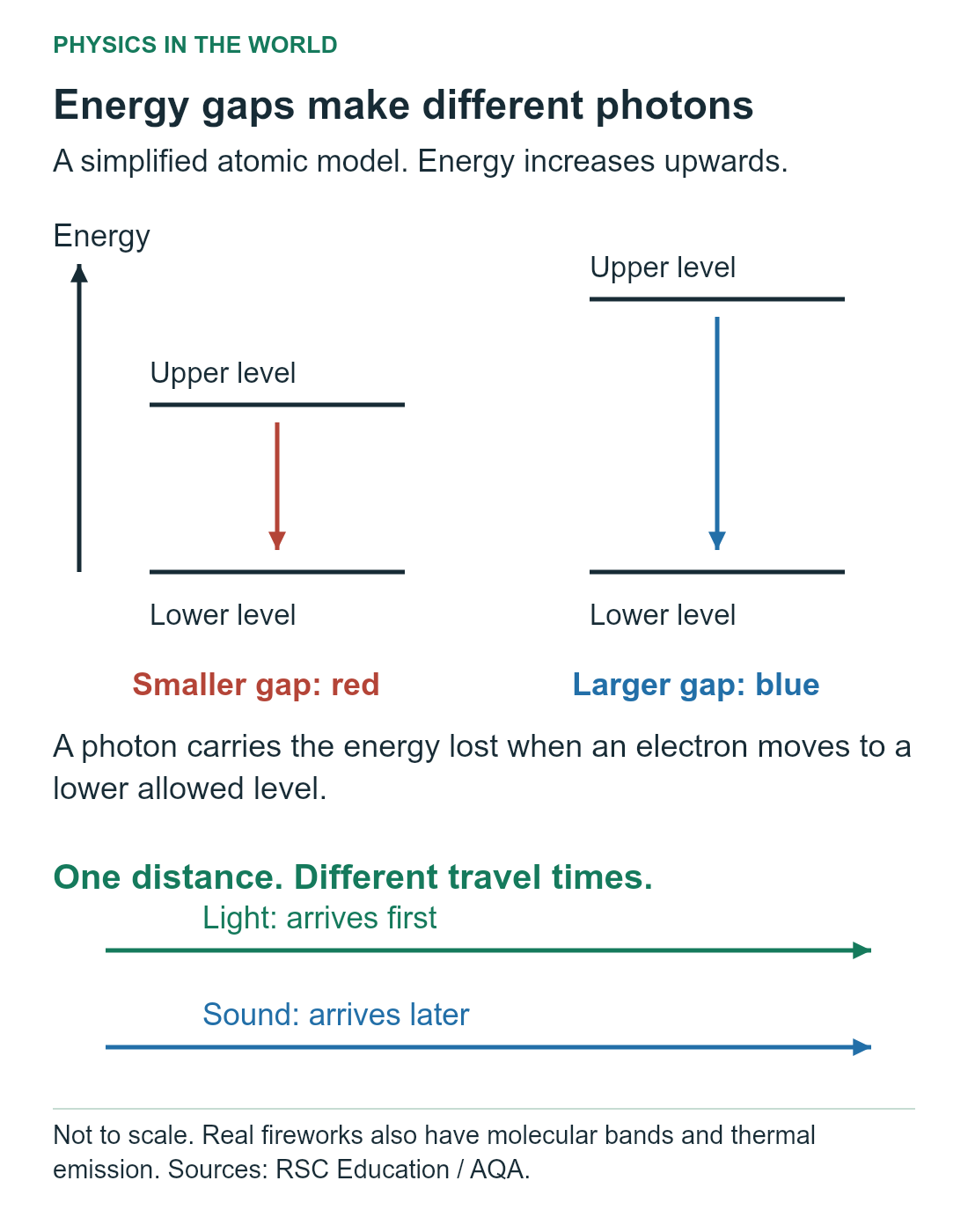
When the electron moves to a lower allowed level, the atom can emit a photon, a packet of light energy. The photon carries the energy difference between those levels.
A bigger energy difference produces a photon with a higher frequency and a shorter wavelength. Within visible light, a blue photon has more energy than a red photon. The diagram compares the two changes without making you calculate either.
Different atoms have different allowed levels, so their sets of emitted wavelengths differ. Molecules have additional ways to store energy, which makes their spectra more complicated. Several nearby wavelengths can form bands rather than the isolated lines in a simple atomic diagram.
You see the flash before hearing the bang because light crosses the distance to you far more quickly than sound. The sound is a disturbance travelling through the air. Its arrival time depends on the distance and the local speed of sound.
Worked equations
The energy gap sets the photon energy
Here h is Planck's constant and f is frequency. Compare the gaps in the diagram: the larger gap produces the higher-frequency photon. These are teaching levels, not a calculation of a commercial firework colour.
What a display can tell you about light
The same idea is used far beyond fireworks. A spectrometer separates light by wavelength. Scientists compare the resulting pattern with known spectra to investigate the material producing the light.
An overall colour is less specific than a measured spectrum. Two mixtures can look similar to your eyes while producing different wavelength patterns. Looking green is therefore not enough, by itself, to prove which substance is present.
For a simple observation at an organised display, notice the delay between a clear flash and its matching bang. A longer delay generally means the source is farther away. Echoes, overlapping shells and a long burst can make it difficult to decide which sound belongs to which flash.
RoSPA recommends professionally organised public displays as the safest way to enjoy fireworks. Watch from the designated area and follow the organisers' instructions. This explanation is about observing light and sound, not trying mixtures or taking fireworks apart.
The GCSE and A-level connections
At GCSE, separate the energy pathways. A chemical reaction transfers energy to the surroundings, producing hot material, moving gases, light and sound. An explosion does not create energy from nothing.
At AS and A level, use the photon-model worksheet to connect frequency with the energy of an individual photon. A photon is emitted in a transition between energy levels; a drawn wavy line represents the light, not the path an electron takes out of the atom.
The particles and radiation worksheet develops excitation and ionisation. Excitation raises an electron to another allowed level while it remains bound. Ionisation removes an electron from the atom. The two words should not be used interchangeably.
The waves worksheet connects speed, frequency and wavelength. Sound needs a material medium, while light is an electromagnetic wave and can travel through a vacuum. Both can transfer energy, but they are different kinds of disturbance.
A photonics engineer uses the same distinctions when choosing a light source or detector. Its colour, intensity and spectrum affect what an optical system can measure.
A Level stretch: brightness is not photon energy
Suppose one red emission line gets brighter while staying at the same wavelength. The energy of each photon in that line stays the same. More photons arriving each second can increase the measured power without increasing their individual energy.
Heating a real mixture can also change which states and chemical species are present. Several lines and bands may strengthen or weaken, so the overall perceived colour can change. That is more complicated than saying every photon becomes more energetic when the flame gets brighter.
Hot solid particles add another complication: thermal radiation covers a broad range of wavelengths. An atomic line diagram explains one process well, but it should not be presented as a complete model of every spark in a display.
To investigate colour properly, measure a spectrum and check the detector response and background. A phone photograph records what you saw, but automatic exposure and colour processing make it a poor substitute for a calibrated spectral measurement.
Key words
Quick pupil questions
Why are fireworks different colours?
Different colour-producing substances emit different sets of wavelengths when heated. Atomic and molecular energy changes, together with light from hot particles, contribute to the colours we see.
Why do you see fireworks before hearing them?
Light travels much faster than sound in air. Both leave the display, but the sound takes longer to reach you.
Does a brighter firework have more energetic photons?
Brightness alone does not tell you photon energy. At the same wavelength, each photon has the same energy; more photons arriving each second can make the light brighter.
How do fireworks link to A-level physics?
They give examples of excitation, photon emission, discrete energy levels, spectra and wave speed. A simple atomic model explains individual emission lines; real mixtures also produce molecular bands and thermal radiation.