
When is the 2026 Physics Nobel Prize announced?
The Nobel Prize in Physics 2026 is scheduled to be announced on Tuesday 6 October at the Royal Swedish Academy of Sciences. The official earliest time is 11:45 CEST, which is 10:45am BST in the UK. "At the earliest" matters: it is not a guarantee that the names will appear at precisely that minute.
As this guide is prepared on 3 October, there is no confirmed 2026 winner to explain. Names circulating beforehand are predictions, not the award result. The official announcement, press release and science background should be the starting point once the result is available.
In the meantime, it is worth understanding how to read a physics prize story. The year on the medal is the year of the award, not necessarily the year the key experiment happened. Important work can take a long time to test, develop and reveal its wider consequences.
The 2025 award makes a good example. John Clarke, Michel H. Devoret and John M. Martinis were recognised for experiments demonstrating quantum tunnelling and quantised energy in an electrical circuit. Their central experiments took place in 1984 and 1985. The following sections explain that previous award, not an unannounced 2026 discovery.
A previous prize: quantum physics in a circuit
In everyday life, a moving object can have a wide range of energies. You can push a swing a little harder or a little less hard. At the quantum scale, some systems behave differently: the allowed energy states come in separate steps.
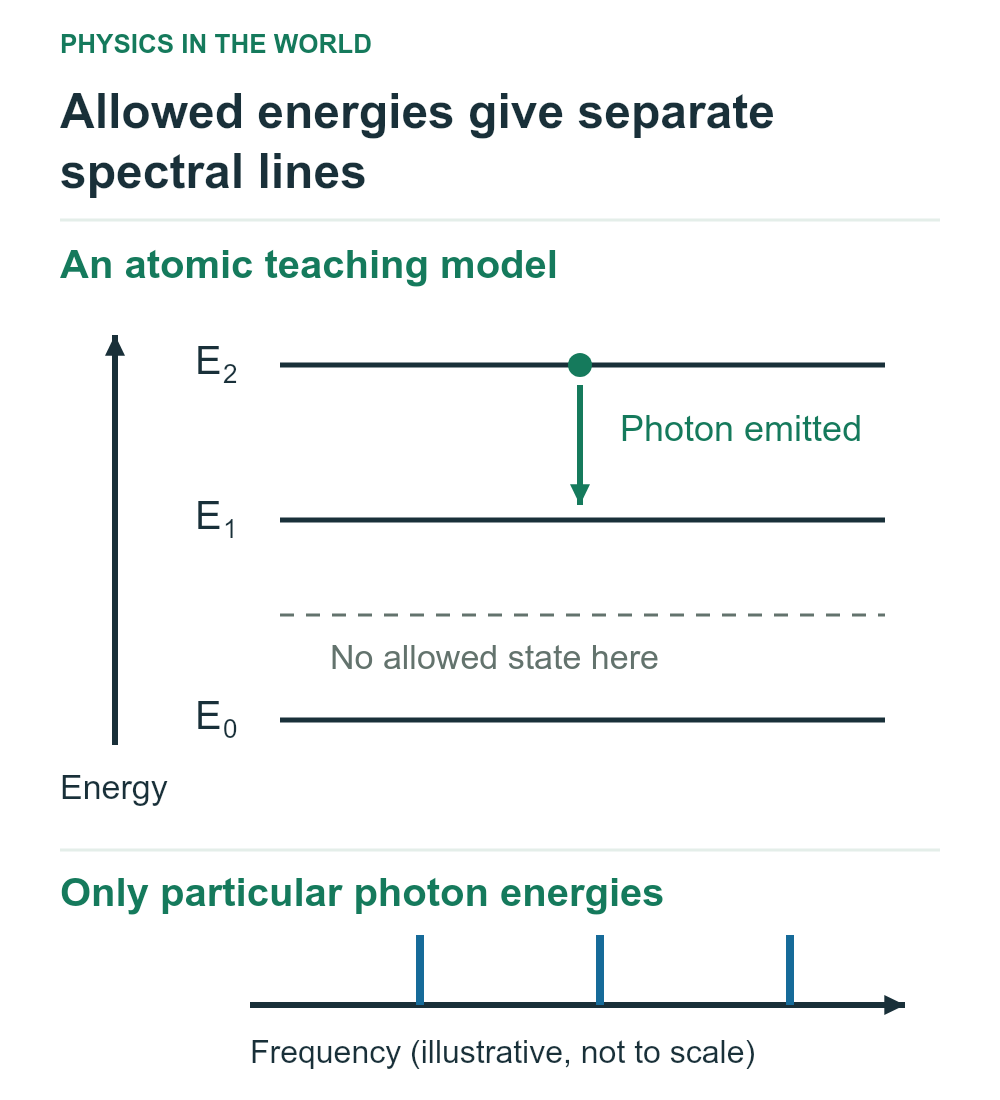
An atom is a familiar school example. Its electrons can occupy particular energy states. An electron moving between two of those states must gain or lose the appropriate energy difference. It cannot finish in an arbitrary state halfway between them.
If that energy difference leaves as electromagnetic radiation, the emitted photon has that energy. This is why atoms can produce line spectra rather than every possible colour. Each line corresponds to a particular allowed transition. The diagram uses this atomic teaching model; it is not a drawing of the Nobel experiment.
The 2025 work asked whether quantum behaviour could be observed in a specially made electrical circuit. The researchers used superconducting components and a junction between them. The relevant quantum behaviour involved a collective electrical state, not just one isolated electron in a school atomic diagram.
Tunnelling is a second idea. A quantum system can have a probability of crossing an energy barrier even when a classical model would not allow the corresponding motion over it. It is not a way to create energy, and it does not mean an everyday person can reliably walk through a wall.
Why does this kind of discovery matter?
The interesting result was experimental, not just a colourful analogy. A circuit built and measured in a laboratory showed behaviour requiring a quantum explanation. That widened the range of systems in which physicists could investigate quantum effects.
A superconducting circuit also gives engineers something they can design, connect and control. The official 2025 background explains how this line of work helped establish a foundation for superconducting quantum technologies. It does not follow that every quantum computer is useful for every task or that ordinary computers will disappear.
There is another lesson for pupils: a discovery can matter before it becomes a familiar product. Testing a physical idea carefully can open up possibilities that were not the original goal. It is sensible to separate what an experiment demonstrated from applications that are still being developed.
When the 2026 result is announced, ask three questions. What exactly was measured or discovered? What previous explanation did it improve or test? What can researchers do with that knowledge now? Those questions are more helpful than assuming that the most dramatic headline is the most accurate one.
Check the date on every page you share. A convincing explainer about last year's winner is still about last year's winner. This guide keeps that distinction visible so that preparation for the announcement does not accidentally become misinformation.
The physics you can already recognise
Start with energy stores and changes: the energy-accounting principle does not stop working when a system is quantum. A photon emitted during a transition carries energy away. The system loses the corresponding amount; the energy is transferred, not destroyed.
The photon model of electromagnetic radiation links a photon's energy to its frequency. Greater energy per photon means greater frequency. Increasing the number of identical photons increases the total energy without changing their individual frequency.
A Level pupils can connect this to emission spectra and energy-level diagrams. A line spectrum is evidence about allowed differences in energy. It is not a photograph of electrons moving along little circular tracks.
An electrical engineer may work on low-noise electronics, control systems or measurement hardware needed to test a device. A data scientist may help distinguish a genuine pattern from noise. Experimental physics depends on these skills as well as the person proposing a new theory.
A Level stretch: how would you test quantisation?
Imagine scanning the frequency of radiation applied to a system and recording its response. If energy absorption is concentrated near particular frequencies, that can support a model with particular energy differences. A broad response or an instrumental artefact needs a different interpretation.
One peak alone is not enough to establish every claim about a system. Researchers need calibration, control measurements and checks that ordinary effects do not explain the signal. Repeating the experiment under changed conditions tests whether the model still predicts what happens.
Use the same thinking as in uncertainties in measurements. A precise number can still be wrong because of a systematic error. Repeated readings can reduce random uncertainty without fixing the calibration. Scientific confidence comes from the combination of evidence, uncertainty and successful tests, not from the prestige of the headline.
Key words
Quick pupil questions
When is the Nobel Prize in Physics 2026 announced in UK time?
The official schedule gives Tuesday 6 October 2026, 11:45 CEST at the earliest. That is 10:45am BST in the UK.
Who won the Nobel Prize in Physics 2026?
As this pre-announcement guide is prepared on 3 October 2026, the winner has not been announced. Check NobelPrize.org after the scheduled announcement on 6 October.
What did the 2025 Physics Nobel Prize recognise?
The previous award recognised John Clarke, Michel H. Devoret and John M. Martinis for experimental work on quantum tunnelling and quantised energy in an electrical circuit.
What does energy quantisation mean?
Some physical systems have particular allowed energy states rather than a continuous choice of every energy. A transition between states involves the appropriate energy difference.