

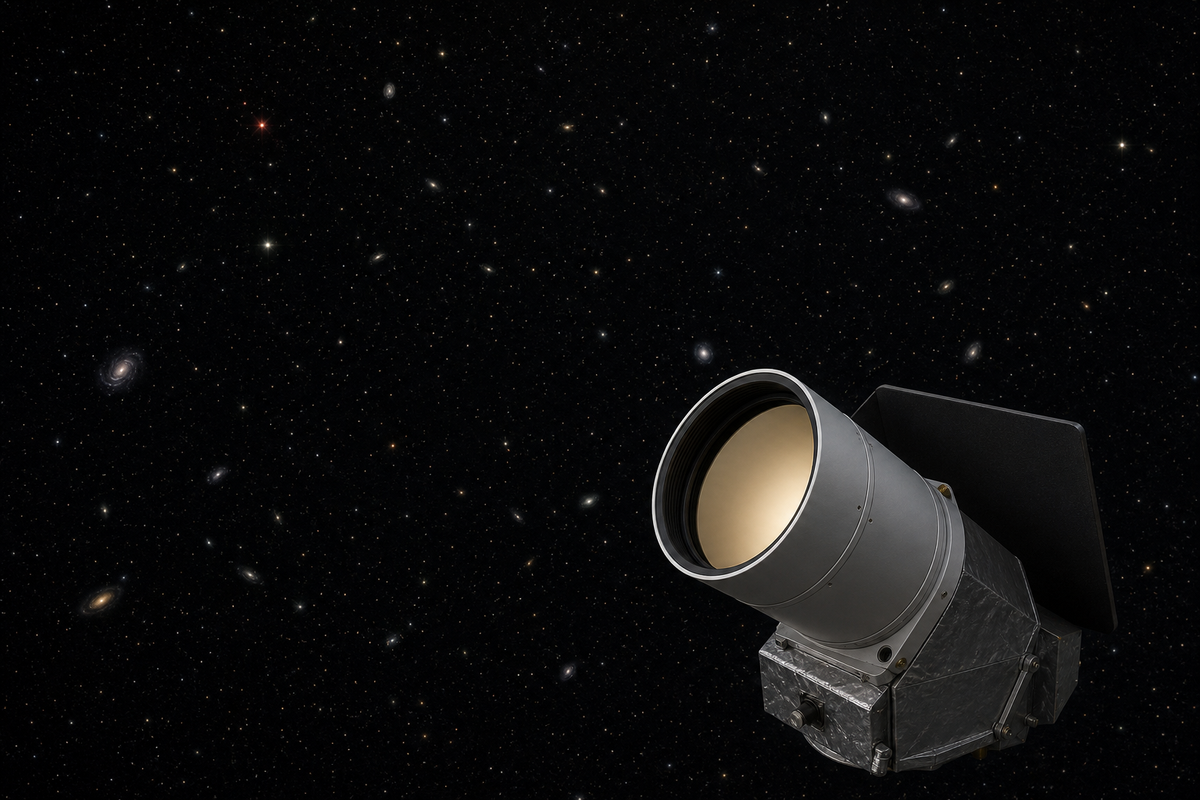
What happened?
The European Space Agency announced that its Euclid space telescope has found 31 very early quasars. The record-holder, EUCL J172902.75+641018.1, has a measured redshift of 7.77; that means the light we receive now left it when the Universe was about 670 million years old.
A quasar is the intensely bright centre of a galaxy where material is falling towards a supermassive black hole. Gas in the accretion disc becomes extremely hot as it loses energy and angular momentum, so the central region can outshine the rest of its galaxy by a huge amount.
These objects are difficult to find. Their ancient light is faint and can be confused with much closer objects, including cool stars in our own Galaxy. Euclid surveyed a very large area of sky, then astronomers selected likely candidates and confirmed their distances using observations of their light.
Euclid is especially useful because it can observe near-infrared light. For a very distant quasar, light that began in the ultraviolet or visible region has had its wavelength stretched during its journey. By the time it reaches us, important spectral features can lie in the infrared.
The simple version
Think of an atom's spectrum as a barcode. Atoms absorb or emit particular wavelengths, so a spectrum contains recognisable lines. Astronomers compare the wavelength of a known line in a laboratory with the wavelength of the same line from a distant object.
If every line has moved to a longer wavelength, the light is redshifted. At small redshifts this is similar to the Doppler effect you meet with sound. Across most of the Universe, however, the more useful explanation is that space expanded while the light was travelling, stretching the wave with it.
A redshift of 7.77 does not mean the quasar is coloured 7.77 times redder. It means the observed wavelength is 8.77 times the wavelength at which that light was emitted. That is why an ultraviolet feature can arrive at an infrared detector.
Looking farther into space also means looking further back in time, because light has a finite speed. The Euclid result is not a live picture of these quasars today. It is a view of their galaxies when the Universe was still in its first billion years.
Worked equations
Using a spectral line to find the record redshift
This is a pupil-friendly worked example using the 121.6 nm Lyman-alpha wavelength and Euclid's reported redshift. Real quasar confirmation uses full spectra, careful calibration and more evidence than one arithmetic step.
- Equivalent redshift form: 1 + z = lambda_obs / lambda_emit = 8.77
- Infrared conversion: 1066.4 nm = 1.0664 micrometres
Why Euclid needs near-infrared observations
The calculation moves a far-ultraviolet line to just over one micrometre, in the near-infrared. It shows why detector sensitivity across the electromagnetic spectrum matters in astronomy.
- Conversion to metres: 1.0664 micrometres = 1.0664 x 10^-6 m
- Observed wavelength is longer: 1066.4 nm / 121.6 nm = 8.77
Why it matters
The result is more useful than one new distance record. Euclid has found enough early quasars for astronomers to begin studying a population rather than relying only on a few unusually bright examples. That makes comparisons with models of early galaxy and black-hole growth more meaningful.
The quasars come from the epoch of reionisation, when energetic light from the first stars and galaxies changed much of the hydrogen between galaxies from neutral atoms into ionised plasma. Quasars act as bright background sources that help researchers test what that early material was like.
It is also a measurement story. A rare discovery required a telescope, infrared detectors, an enormous survey, careful data processing and follow-up observations. That is a useful reminder that modern physics is often about designing instruments that can distinguish a faint real signal from many convincing lookalikes.
Physics you already know
Photons carry electromagnetic radiation across space. Their wavelength tells us where they lie on the electromagnetic spectrum, and their energy changes as wavelength changes. Euclid uses that relationship when it detects very stretched light in the near-infrared.
Spectra are evidence, not decoration. A laboratory wavelength gives astronomers a reference value. Comparing it with an observed wavelength lets them calculate redshift, just as a shift in a familiar sound frequency can give information about motion.
The worked example is a useful standard form and unit-conversion exercise: nanometres, micrometres and metres are all the same physical wavelength expressed on different scales. Keeping powers of ten clear is essential before comparing detector ranges.
The story connects the life cycles of stars and galaxies with cosmology. Early stars made energetic radiation, while the black holes at the centres of some galaxies were already growing quickly enough to power quasars. Observations of their redshift support the picture of an expanding Universe.
Science ideas to understand
Redshift is a ratio, not a colour label
Redshift compares an observed wavelength with a known emitted wavelength. A large value means a large fractional stretch; it does not describe the colour of an object in an ordinary photograph.
A quasar is not the black hole itself
The black hole does not shine directly. The brilliant light comes from hot matter around it, especially the accretion disc, before that matter crosses the event horizon.
Infrared is still electromagnetic radiation
Infrared waves have longer wavelengths and lower photon energies than visible light. Astronomers use different detectors because the same source can appear in different parts of the electromagnetic spectrum.
A record is not the final answer
One record-setting quasar is exciting, but the scientific value grows when researchers can compare many objects, quantify selection effects and test whether a model predicts the whole observed population.
A Level stretch
For cosmological redshift, physicists often write 1 + z = a_today / a_emit, where a is the scale factor of the Universe. At z = 7.77, the scale factor at emission was about 1 / 8.77 of its value today. This describes the expansion of large-scale space, not the stretching of atoms, people or galaxies held together by forces.
Do not use the small-redshift approximation v = zc for this quasar. At z = 7.77 it would wrongly imply a speed greater than c. Very large cosmological redshifts need general-relativistic cosmology, where the recession rate comes from the changing scale factor rather than a simple object flying through static space.
A high-redshift candidate can be selected from its brightness in several filters because intervening hydrogen absorbs parts of its ultraviolet spectrum. Follow-up spectroscopy then checks whether the pattern of shifted features is consistent with a quasar at the claimed redshift instead of a much closer star or galaxy.
There is a distinction between lookback time, comoving distance and light-travel distance. Saying that a quasar is seen as it was 670 million years after the Big Bang is a time statement. Its present-day distance is not found by simply multiplying 13 billion years by c, because the Universe expanded while the light travelled.
Key words
Quick pupil questions
What did Euclid discover in 2026?
Euclid identified 31 very early quasars, including EUCL J172902.75+641018.1 at redshift 7.77. Its light shows the object as it was when the Universe was about 670 million years old.
How does redshift show that the Universe is expanding?
Light from a distant object has characteristic spectral wavelengths. If the expansion of space stretches that light during its journey, astronomers observe the same features at longer wavelengths and calculate a positive redshift.
Why did Euclid need infrared detectors to find ancient quasars?
A large redshift moves ultraviolet and visible features to longer wavelengths. For the z = 7.77 classroom example, a 121.6 nm feature is observed at about 1066 nm, in the near-infrared.
How does this link to A Level Physics?
It links photons, electromagnetic waves, wavelength, spectra, redshift, standard form, cosmology, the expanding Universe and the careful interpretation of evidence.