

What happened?
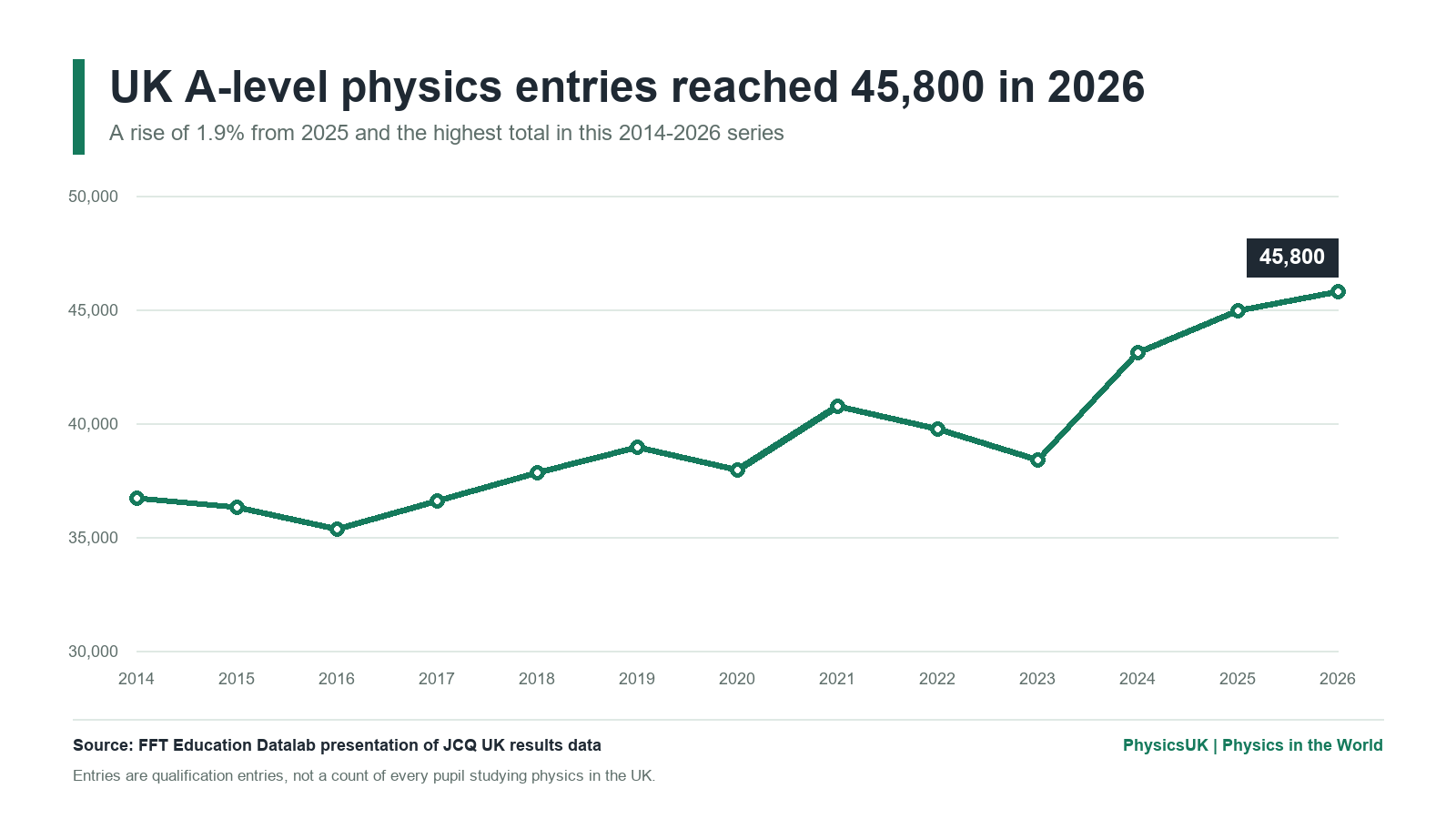
The 2026 UK results include 45,800 A-level physics entries, 843 more than in 2025. That is a rise of 1.9% and the highest total in the 2014-2026 series presented by FFT Education Datalab from the national results data.
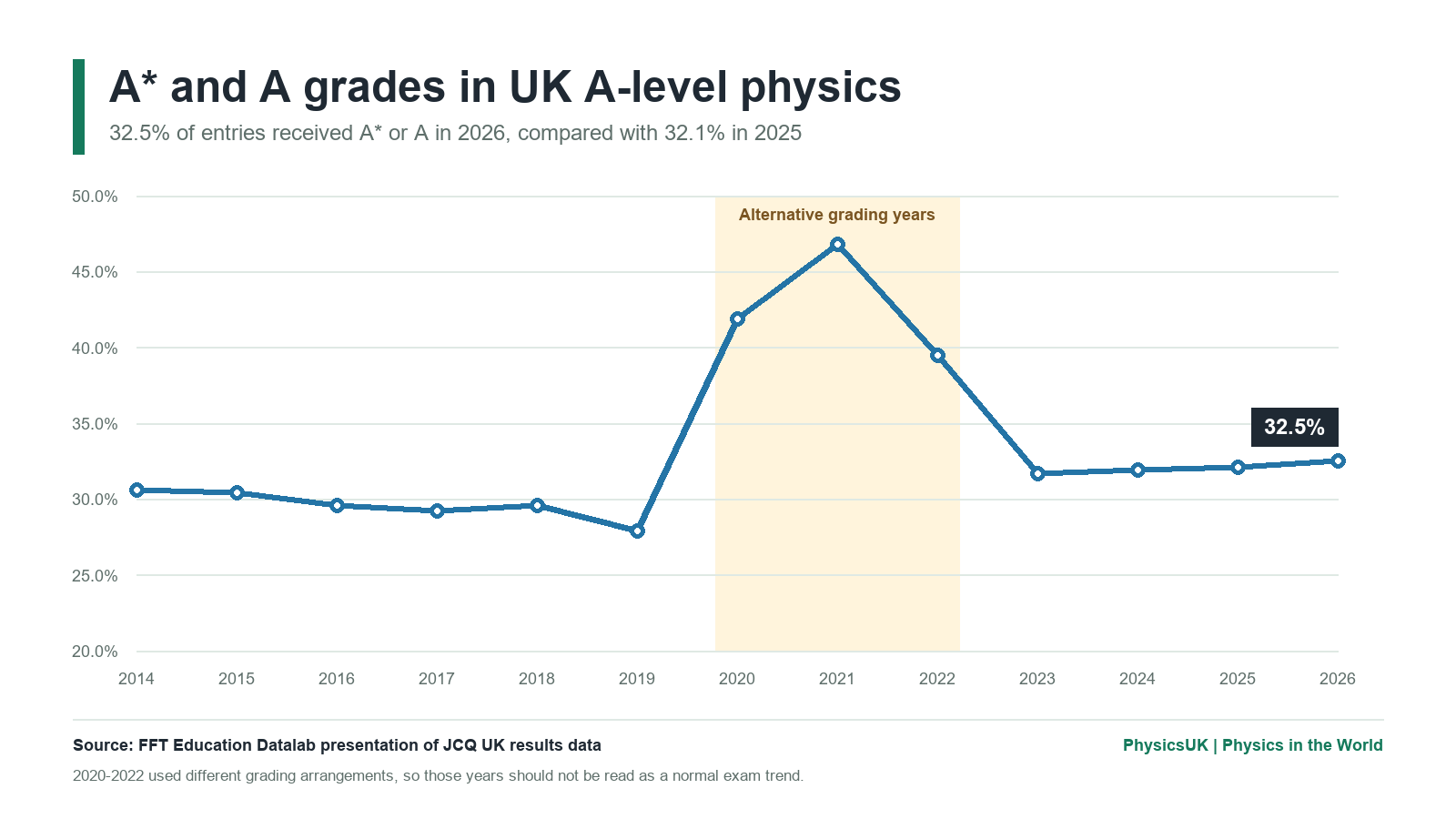
Of those entries, 11.5% received A*. In total, 32.5% received A* or A, 54.3% received at least a B and 73.2% received at least a C. The A*-E figure was 95.7%. These are cumulative percentages, so the 32.5% includes the 11.5% who received A*.
Physics participation has grown strongly since 2023, when there were 38,379 entries. The total rose to 43,114 in 2024, 44,957 in 2025 and 45,800 this year. The size of the annual increase has slowed, but the direction over those three years is still upward.
There were 10,854 female entries in 2026, which is 23.7% of the total. That is close to one in four, but it also shows that the long-standing participation gap remains. Entry growth by itself does not tell us whether access to physics has become more equal.
The simple version
These figures count exam entries, not individual pupils. A pupil taking Physics and Chemistry creates one entry in each subject. Entry totals help us compare subjects and years, but they do not describe every pupil's experience of studying physics.
A cumulative grade percentage is the share of entries receiving that grade or a higher one. It is not a target that examiners have to hit. Ofqual says grade boundaries are set after marking and can move when a paper is harder or easier. There is no quota for the number of pupils who can receive each grade.
The large jump in top grades during 2020 and 2021 needs a warning label because exams and grading operated differently during the pandemic. For a fairer recent comparison, 32.5% at A*-A in 2026 can be compared with 32.1% in 2025 and 31.9% in 2024.
The UK total also combines systems that are not identical. England, Wales and Northern Ireland do not all use AS qualifications in the same way. That matters when we interpret the AS graph and when pupils ask whether an AS result predicts their final A-level result.
What happened to AS Physics results in 2026?
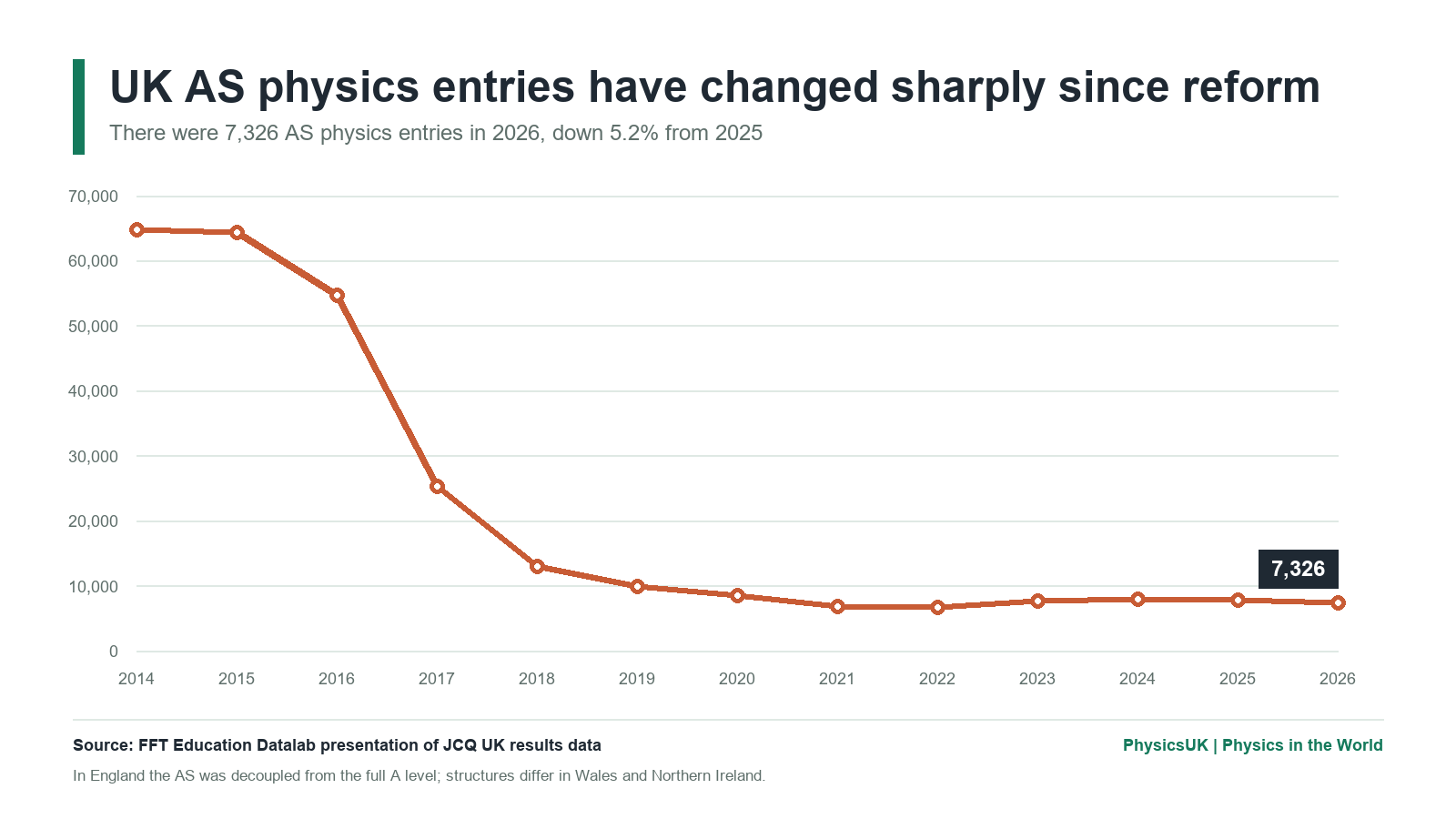
There were 7,326 UK AS physics entries in 2026, down 402 from 2025. That is a fall of 5.2%. Among those entries, 27.3% received grade A, 45.7% received A or B, 62.4% received A-C and 87.2% received A-E.
The long-term fall is much larger than one year. There were 64,790 AS physics entries in 2014. A major reason is structural: in England, reformed AS qualifications became standalone qualifications and stopped contributing to the final A-level grade. Many English schools now teach the first year of the full A level without entering pupils for AS exams.
Why has the AS graph fallen so sharply?
In England, many pupils still study Physics in Year 12 but do not sit a separate AS exam. They continue on the two-year A-level course instead. The fall in AS exam entries therefore does not show how many pupils have stopped studying Physics.
Does your AS grade count towards your A level?
In England, the standalone AS grade does not count towards the final A-level grade. The rules are different in Wales and Northern Ireland. Your school or college can confirm which qualification you are taking and how your result is used.
What should I do if I did not get the result I wanted?
Pause before deciding that one grade has closed every route. Start by checking your application status in the UCAS Hub and speaking to your teacher or adviser. Contact the university or college directly if its decision is unclear or you missed the offer narrowly.
On 2026 results day, UCAS began updating applications from 08:00 on 13 August. Eligible applicants can add a Clearing choice from 13:00. You can research and speak to more than one university, but only add a choice after receiving an offer that you are prepared to accept.
Ask what the result actually changes
Your firm place may already be confirmed, an insurance offer may apply, or a university may still be considering you. Check before assuming.
Use Clearing carefully
Compare course content, location, costs, accommodation and any foundation-year route. A quick available place is only useful if the course still suits you.
Discuss a review of marking
For an internal candidate, the school or college requests a review. Marks and grades can go down as well as up, so discuss the script, boundaries, deadlines and likely benefit before giving consent.
Consider another route
A foundation year, degree apprenticeship, HNC or HND, resit, gap year, employment or a related course can still lead towards technical work. The right route depends on the career, not on keeping the original plan unchanged.
Look at the work behind physics
Physics can lead into roles such as data scientist, research scientist, electrical engineer, medical physicist and physics teacher. Entry routes differ, so compare the actual profile and qualifications each one needs.
Get independent support
The National Careers Service Exam Results Helpline offers free advice in England on 0800 100 900 during the results period.
Does AS Physics lead to the full A level?
There is no honest national progression percentage that can be made by dividing 7,326 AS entries by 45,800 A-level entries. They are not the same cohort, and many full A-level pupils never enter a standalone AS exam. A ratio made from those two totals would look precise but answer the wrong question.
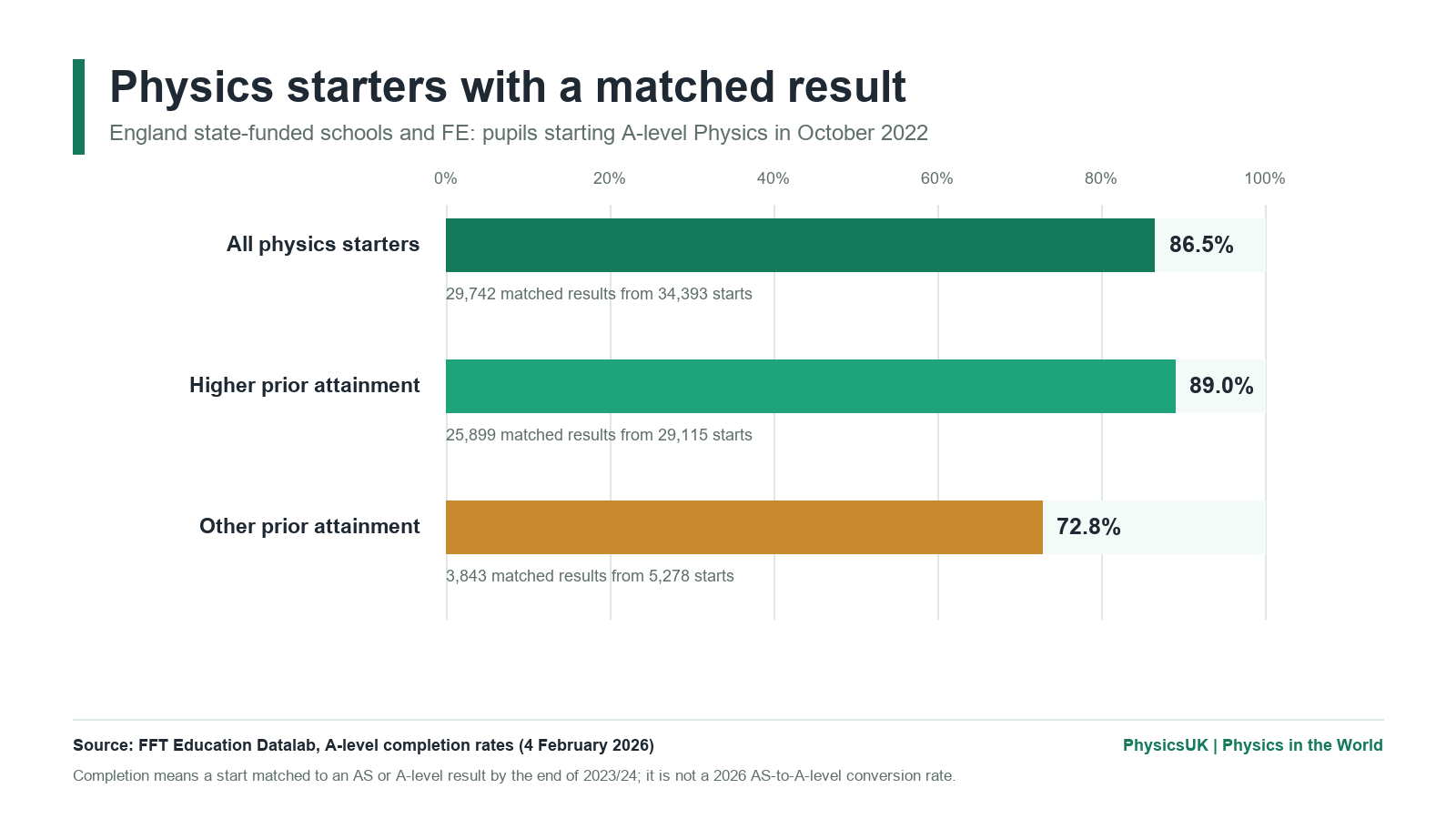
A separate FFT Education Datalab study followed 34,393 pupils who started A-level Physics in England state-funded schools and FE in October 2022. By the end of 2023/24, 29,742 had a matched AS or A-level result under the study's definition. That is 86.5%. It must not be simplified to "86.5% finished the full A level" because a matched AS result also counted.
The matched-result rate was 89.0% for pupils with higher prior attainment and 72.8% for the other group. These figures provide context, but they do not predict what any individual pupil will do.
If you are moving into Year 13, use your result alongside teacher feedback, attendance, practical work and the support available to you. The AQA AS-to-A-level transition guide and OCR A AS-to-A-level transition guide show the first-year topics to secure before the more mathematical second year.
A grade is evidence, not destiny
Look at where marks were lost. Weak algebra, units or explanations can often be repaired with focused work; a single letter does not diagnose the cause.
Expect first-year knowledge to return
Full A-level papers are synoptic. Mechanics, electricity, waves, particles, graphs and uncertainty remain live material in Year 13.
Why it matters
A record entry total matters because advanced physics is a route into engineering, computing, energy, medicine, teaching and research. More entries can widen the future skills base, although subject totals alone cannot tell us where pupils come from or whether every group has equal access.
The results also show why national statistics and personal decisions must be separated. A national A*-A percentage describes thousands of entries. It cannot tell a pupil whether they should continue, which university will accept them or what support would change their next result.
Results-day data can still be useful when it is handled carefully. It lets us identify long-term participation trends, compare grade distributions, ask where inequalities remain and challenge claims that are based on one dramatic percentage without context.
Physics you already know
This article uses the same data analysis habits as a physics practical. Define the quantity before comparing it, label axes and units, calculate percentage changes from the correct starting value, and distinguish a real trend from a one-year fluctuation.
A graph also needs evaluation. The pandemic grading years are a change in method, so they cannot be treated as ordinary points in the same experimental run. The AS series contains a qualification reform, which is another change that affects the meaning of the data.
Selection effects matter in the completion study. Pupils who choose A-level Physics are not a random sample of every GCSE pupil, and the higher-attainment and other groups may differ in several ways besides prior grades. A correlation in the graph is not proof that one variable alone caused the outcome.
These skills appear throughout A-level practical skills revision: uncertainty, percentage change, graph interpretation and evaluating whether evidence supports a conclusion. They are also part of the daily work of a data scientist and of a physics teacher deciding how to support a class.
A Level stretch
The entry graph is a repeated cross-section, not a longitudinal study. It counts a new set of candidates each year. The completion analysis is longitudinal because it links a starting cohort to later outcomes. Those study designs answer different questions.
Cumulative grade percentages are useful but easy to misread. Since 32.5% received A or above and 11.5% received A*, the share receiving exactly grade A is 21.0 percentage points. Subtracting adjacent cumulative percentages gives the share in one grade band.
The 86.5% completion figure includes a matched AS result where a pupil started an A level but later completed the lower qualification. It should therefore be described using the study definition rather than simplified to "86.5% finished the full A level".
A strong statistical account states its population, time period and denominator. Here that means separating final UK results, provisional England entry statistics and the earlier England completion cohort rather than blending them into one number.
Key words
A-level Physics results 2026: common questions
How many students took A-level Physics in 2026?
There were 45,800 UK A-level Physics entries in 2026. Entries are qualification registrations, so the figure is best described as entries rather than a perfect count of unique pupils.
What percentage got an A* in A-level Physics in 2026?
11.5% of UK A-level Physics entries received A* in 2026. The cumulative A*-A figure was 32.5%.
What was the A-level Physics pass rate in 2026?
95.7% of UK entries received grades A*-E. Calling this a pass rate is common, although universities, employers and schools may require a higher grade for a particular route.
How many AS Physics entries were there in 2026?
There were 7,326 UK AS Physics entries, 5.2% fewer than in 2025. The total is much lower than before qualification reforms, especially because many pupils in England now take the full A level without entering a standalone AS exam.
Does an AS Physics result count towards the full A level?
In England, the reformed AS is standalone and does not contribute to the final A-level grade. Arrangements differ in Wales and Northern Ireland, so check the rules for your qualification and awarding body.
Should I continue Physics into Year 13 after my AS result?
Use the grade with your teacher feedback, topic-level marks, practical work, maths confidence and available support. Ask your school about its progression policy; there is no single national grade rule that fits every pupil.
What should I do if I missed my university offer for Physics?
Check the UCAS Hub, speak to your school or college, and contact the university if the decision is unclear or you missed narrowly. If you are eligible, compare Clearing courses and alternatives such as foundation years or degree apprenticeships before adding a choice.
Can an A-level grade change after a review of marking?
Yes. A review can leave the mark unchanged or move it up or down. Internal candidates normally request it through their school or college and must give consent after discussing the risk, cost and deadline.
Are A-level grade boundaries fixed before exams?
No. Ofqual says awarding organisations set boundaries after papers have been marked so changes in paper difficulty can be taken into account. There are no quotas capping how many pupils can receive each grade.