
Free worksheet and solutions · AQA GCSE · 8463 / 8464
AQA GCSE Physics Terminal Velocity and Changing Forces Worksheet
AQA GCSE terminal velocity worksheet with answers. Explain changing weight and drag effects, calculate resultants and interpret the correct course pathway.
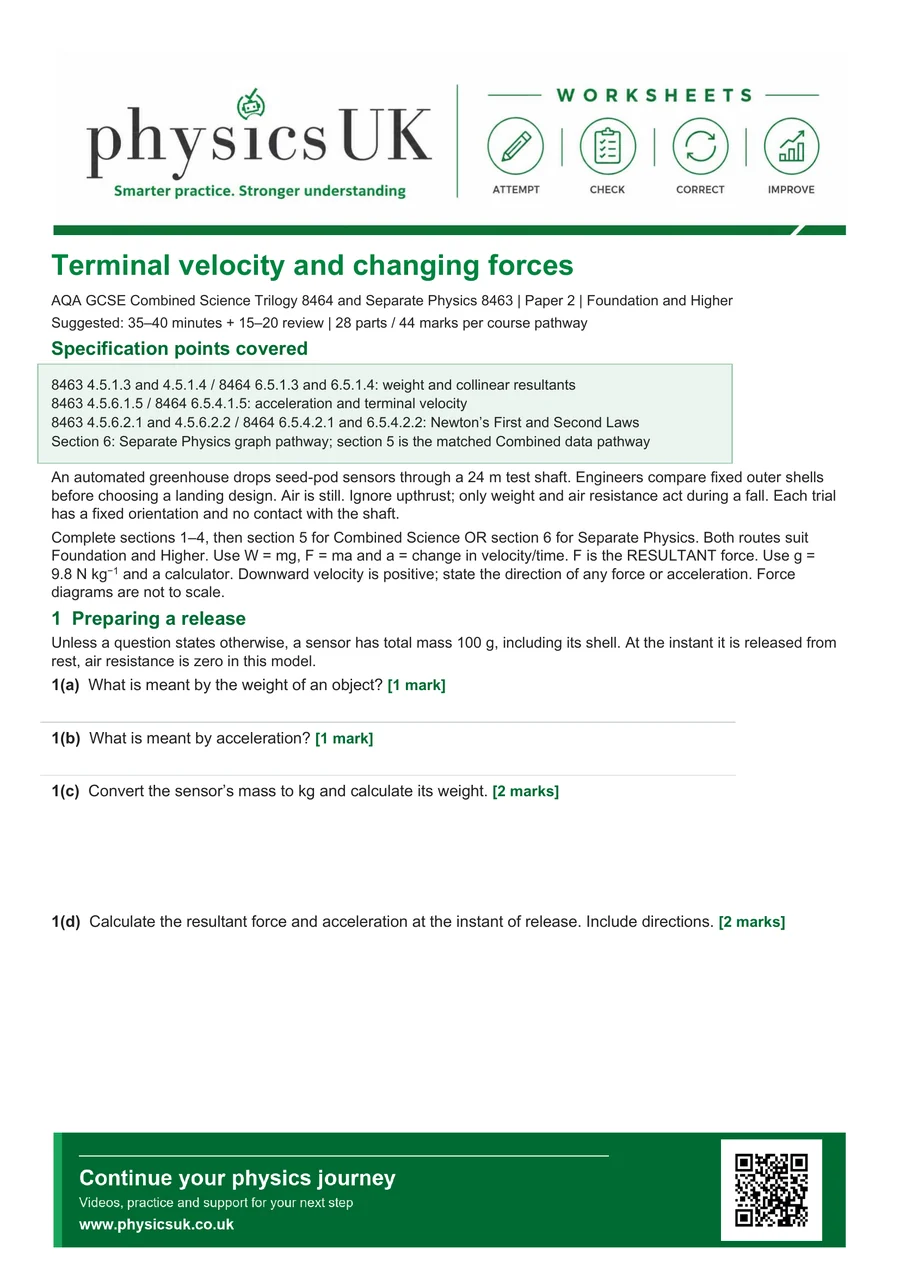
What is covered
Questions and skills covered
The worksheet contains 7 pages of printable questions. A separate 7-page solutions PDF makes it easy to mark, review or share answers after the activity.
- 100g to kg and W=mg
- F=ma with resultant not weight alone
- Changing drag snapshots
- Initial9.8m/s² versus later decreasing acceleration
- Terminal nonzero velocity with zero resultant and acceleration
- Fixed-shape drag comparisons
- Equal-mass fair test controls
- Evidence-based landing-speed criterion
- Downward motion slowing under upward resultant
- Internal payload and higher terminal speed
- Language correction velocity increases versus velocity accelerates
- Combined velocity-time table averages
- Separate nonlinear velocity-time graph readings and force-gradient link
About this activity
A greenhouse team compares falling seed-pod sensor shells and decides which meets a supplied landing-speed criterion.
Before you start
After teaching weight, resultant force, F=ma, average acceleration and terminal velocity. Separate route also needs velocity-time graphs. No calculus or drag equation assumed.
A question from the worksheet
Question3(d), pupil page4
A100g sensor moves down at6m/s with1.300Nupwarddrag and0.980Nweight. Determine the resultant and immediate speed change.
Show the answer
0.320Nupwards. It slows while still moving down; it does not instantly reverse.
Common error: Saying smaller acceleration means slowing, using weight instead of net force, or equating zero resultant with zero velocity.
Revise the physics
Specification fit
AQA GCSE Physics Worksheets
8463 and 8464 · 4.5.1.3, 4.5.1.4, 4.5.6.1.5, 4.5.6.2.1, 4.5.6.2.2, 6.5.1.3, 6.5.1.4, 6.5.4.1.5, 6.5.4.2.1, 6.5.4.2.2
- 8463: 4.5.1.3, 4.5.1.4, 4.5.6.1.5, 4.5.6.2.1, 4.5.6.2.2
- 8464: 6.5.1.3, 6.5.1.4, 6.5.4.1.5, 6.5.4.2.1, 6.5.4.2.2
Choose the correct pathway: Combined Trilogy 8464 and Separate Physics 8463, both tiers. Common Sections 1–4, then Combined Section 5 OR Separate Section 6. The graph/force-synthesis ending is course-specific.
Classroom use
Use the worksheet for class practice, homework, intervention, cover work or revision. Keep the PhysicsUK attribution intact when sharing copies with pupils.