
Free worksheet and solutions · AQA GCSE · 8463 / 8464
AQA GCSE Physics Spring Required Practical Graphs and Limits Worksheet
AQA GCSE spring practical worksheet with answers. Analyse force–extension graphs, calculate spring constants and test proportionality and permanent change.
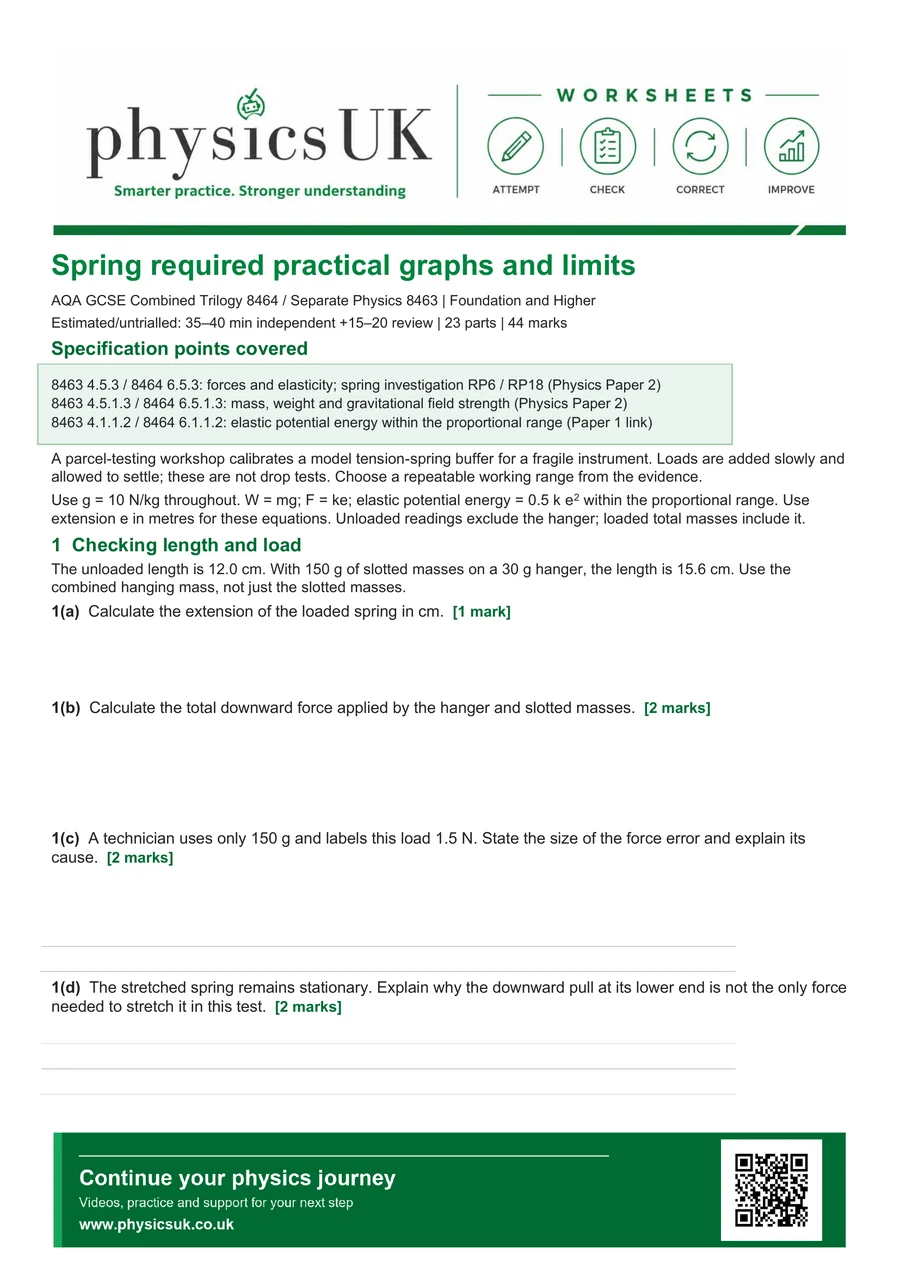
What is covered
Questions and skills covered
The worksheet contains 7 pages of printable questions. A separate 7-page solutions PDF makes it easy to mark, review or share answers after the activity.
- Extension from original unloaded length rather than total length or adjacent row
- Total hanging mass including hanger, grams to kilograms, supplied g and W=mg
- Opposing pulls at spring ends; stationary deformation
- Fixed ruler/datum, lower-spring-end pointer, settling, eye-level reading and clamped stable stand
- Complete force/extension table and plot seven points on a labelled PNG graph
- Force vertical, extension horizontal: proportional gradient 0.5 N/cm = 50 N/m
- Fit only the first five proportional points; identify two unjoined higher-load measurements
- Use linear calibration within its range and reject extrapolation to 3 N
- Last measured proportional force 2 N and first non-proportional 2.5 N bracket, not exactly locate, onset
- Independent unloading trials distinguish non-proportional recovery from permanent extension
- Largest tested working load must meet proportionality and recovery conditions
- Smaller safe load steps and unloading checks answer different experimental questions
- Check anomalies before exclusion; use confirmed valid readings for a mean
- Elastic energy 0.0225 J within proportional range; reject old-k formula outside range
- Scaffolded six-mark-style practical method with original levels rubric and full worked example
About this activity
Use valid measurements and the actual graph axes; distinguish proportional calibration from elastic recovery and support working-limit choices with both kinds of evidence.
Before you start
After teaching forces and elasticity, mass/weight, graph gradients, means and elastic potential energy. Supplied equations and g support application rather than equation recall.
A question from the worksheet
Question 5(b), pupil page 5
Trial B is non-proportional during loading but returns to 12.0 cm. Why does a curved loading graph alone not prove permanent deformation?
Show the answer
It recovers its original unloaded length, so it has no permanent extension in this model. Non-proportional force/extension and failure to recover are different tests.
Common error: Treating the limit of proportionality as automatically the onset of permanent deformation.
Revise the physics
Specification fit
AQA GCSE Physics Worksheets
8463 and 8464 · 4.5.3, 4.5.1.3, 4.1.1.2, 6.5.3, 6.5.1.3, 6.1.1.2
- 8463: 4.5.3, 4.5.1.3, 4.1.1.2
- 8464: 6.5.3, 6.5.1.3, 6.1.1.2
Choose the correct pathway: Combined Trilogy 8464 and Separate Physics 8463, both tiers. Mainly Paper 2 with a Paper 1 elastic-energy link. Written RP6/RP18 preparation; static tests do not certify impact protection.
Classroom use
Use the worksheet for class practice, homework, intervention, cover work or revision. Keep the PhysicsUK attribution intact when sharing copies with pupils.