
Free worksheet and solutions · AQA GCSE · 8463 / 8464
AQA GCSE Physics Motion Graphs 2 Comparing Journeys Worksheet
AQA GCSE motion-graphs worksheet with answers. Compare delivery-robot journeys, read gradients and velocity, and complete the correct tier ending.
What is covered
Questions and skills covered
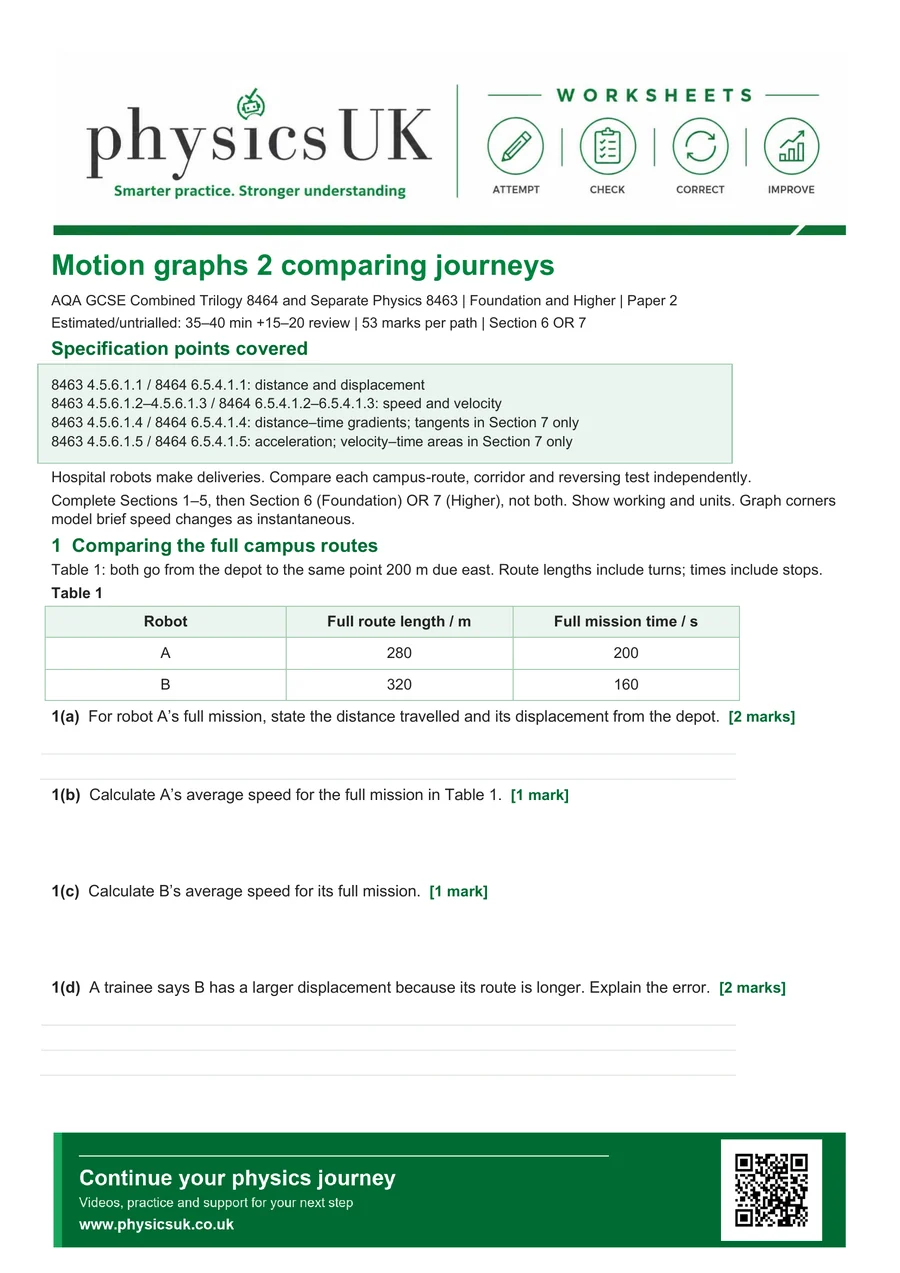
The worksheet contains 7 pages of printable questions. A separate 7-page solutions PDF makes it easy to mark, review or share answers after the activity.
- Distance is path length; displacement has magnitude and direction between endpoints
- Full-route averages 1.4 and 2.0 m/s; both endpoint displacements 200 m east
- Straight distance–time gradients: A first 1 m/s, later 2 m/s; B moving 1 m/s
- Stationary interval 40–80 s; B initial wait 0–20 s
- At 90 s B is 10 m ahead but A is faster
- B catches stationary A at 60 s / 40 m; A overtakes moving B at 100 s / 80 m
- A reaches 120 m at 120 s, B at 140 s; only A meets corridor 130 s deadline
- Overall average includes stopped time and differs from maximum stage speed
- Signed velocity at 18 s is −1 m/s, speed is 1 m/s
- Acceleration +0.5 or −0.5 m/s² from signed change/time
- Negative acceleration slows eastward motion but increases speed westwards in the later interval
- Horizontal distance–time, zero velocity and horizontal nonzero velocity have distinct meanings
- Separate 20 m east / 8 m west event: distance 28 m, displacement 12 m east
- Reliable measured distance markers, timing and comparable repeated trials
- Foundation repeated distance/speed/time substitution and interval averages 1 and 3 m/s
- Foundation full-route 180 s deadline: B meets it by 20 s; A does not
- Higher tangent at 4 s gives about 2 m/s versus first-four-second average 1 m/s
- Higher velocity–time positive area 16 m east and negative-area magnitude 12 m west
- Higher whole-test displacement 4 m east; total distance 28 m
About this activity
Interpret a journey in its physical context before calculating; distinguish a graph reading from a gradient and speed from signed velocity.
Before you start
Distance, displacement, speed, velocity and acceleration after teaching; basic ratios and straight-line gradients. Higher replacement additionally needs tangents and velocity–time areas.
A question from the worksheet
Question 3(e), pupil page 3
Robot B is farther along at 90 s. Does this mean B is moving faster?
Show the answer
No. A has the steeper distance–time gradient: 2.0 m/s compared with B’s 1.0 m/s. Position along the route is not current speed.
Common error: Using the height of a distance–time line as speed, or saying velocity is accelerating.
Revise the physics
Specification fit
AQA GCSE Physics Worksheets
8463 and 8464 · 4.5.6.1.1, 4.5.6.1.2, 4.5.6.1.3, 4.5.6.1.4, 4.5.6.1.5, 6.5.4.1.1, 6.5.4.1.2, 6.5.4.1.3, 6.5.4.1.4, 6.5.4.1.5
- 8463: 4.5.6.1.1, 4.5.6.1.2, 4.5.6.1.3, 4.5.6.1.4, 4.5.6.1.5
- 8464: 6.5.4.1.1, 6.5.4.1.2, 6.5.4.1.3, 6.5.4.1.4, 6.5.4.1.5
Choose the correct pathway: Combined Trilogy 8464 and Separate Physics 8463. Common Sections 1–5, then Foundation Section 6 OR Higher Section 7. Tangents and velocity–time areas are confined to Higher.
Classroom use
Use the worksheet for class practice, homework, intervention, cover work or revision. Keep the PhysicsUK attribution intact when sharing copies with pupils.