
Free worksheet and solutions · AQA GCSE · 8463 / 8464
AQA GCSE Physics Force Diagrams and Vector Resultants Worksheet
AQA GCSE force-diagram worksheet with answers. Identify interacting objects, calculate straight-line resultants and apply the correct tier drawing tasks.
What is covered
Questions and skills covered
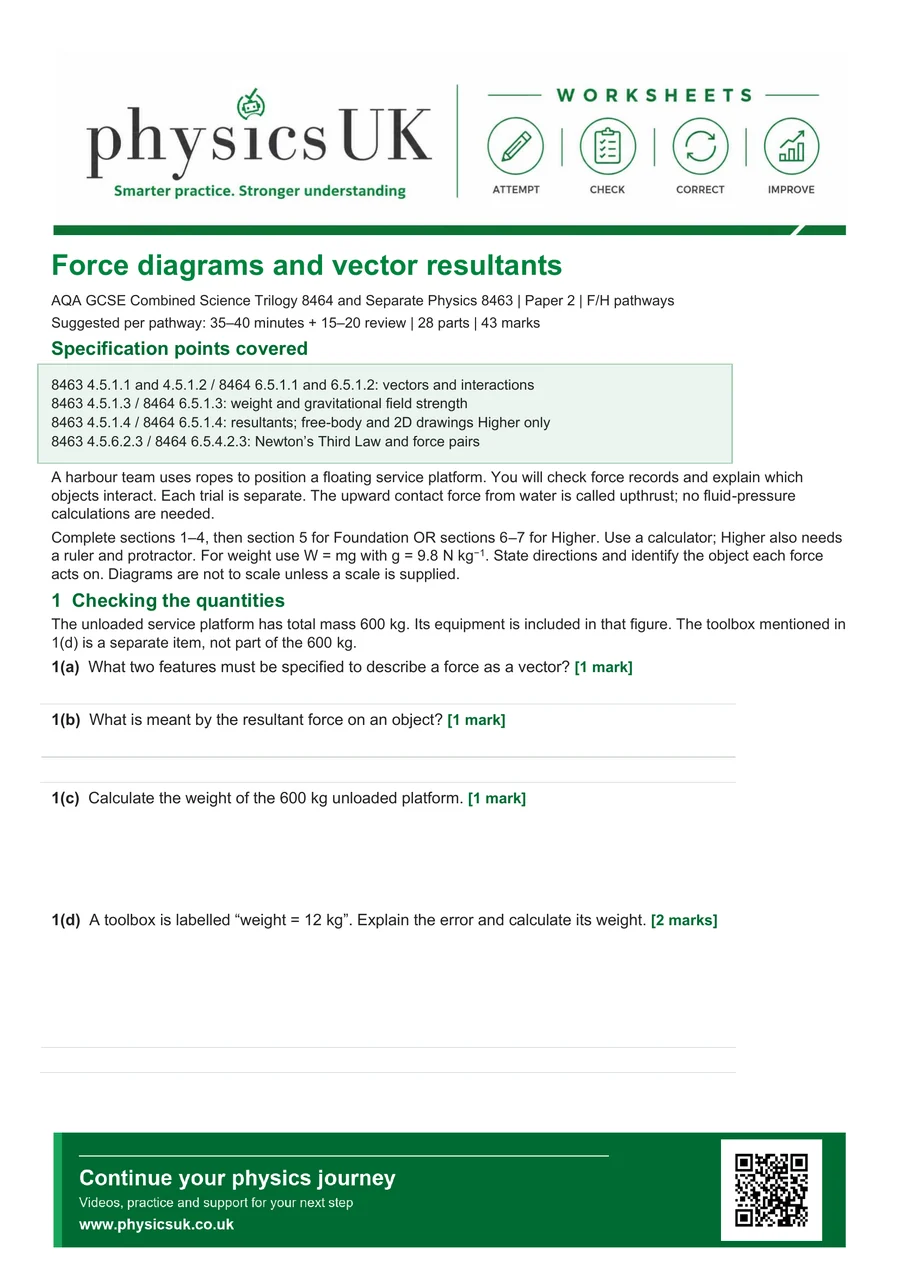
The worksheet contains 7 pages of printable questions. A separate 7-page solutions PDF makes it easy to mark, review or share answers after the activity.
- Magnitude and direction
- Resultant as one equivalent force
- Mass versus weight and W=mg
- Actual-platform one-axis labelled force arrows
- Contact and non-contact interactions
- Collinear addition and subtraction
- Zero resultant versus absence of forces
- Halving a named force versus halving its resultant
- Body-specific Third Law partners
- Earth-platform gravitational interaction
- Same-object balancing weight and upthrust versus Third Law
- Magnet-buoy non-contact force pair
- Foundation single-arrow scale representation
- Foundation added load and vertical force balance
- Higher isolated four-force free-body diagram
- Higher head-to-tail scale vector construction
- Higher magnitude and angle from east
- Higher equal-and-opposite equilibrant
- Higher single-force perpendicular components
About this activity
A harbour team checks a floating service platform’s towing records and distinguishes forces on the platform from forces it exerts on ropes, Earth and another object.
Before you start
After teaching force vectors, interactions, weight, collinear resultants and Newton’s Third Law. Higher also needs free-body and scale-vector construction. No trigonometry assumed.
A question from the worksheet
Question4(d), pupil page4
Why are the platform’s equal weight and upthrust balancing forces but not a Third Law pair?
Show the answer
They act on the same platform and balance. Third Law partners act on different bodies in one interaction; these arise from Earth–platform and water–platform interactions.
Common error: Adding the reaction force on the rope to the resultant on the platform, giving a magnitude without direction, or adding a force and its components as extra forces.
Revise the physics
Specification fit
AQA GCSE Physics Worksheets
8463 and 8464 · 4.5.1.1, 4.5.1.2, 4.5.1.3, 4.5.1.4, 4.5.6.2.3, 6.5.1.1, 6.5.1.2, 6.5.1.3, 6.5.1.4, 6.5.4.2.3
- 8463: 4.5.1.1, 4.5.1.2, 4.5.1.3, 4.5.1.4, 4.5.6.2.3
- 8464: 6.5.1.1, 6.5.1.2, 6.5.1.3, 6.5.1.4, 6.5.4.2.3
Choose the correct pathway: Combined Trilogy 8464 and Separate Physics 8463. Common Sections 1–4, then Foundation Section 5 OR Higher Sections 6–7. Free-body and scaled vector constructions are Higher-only tasks.
Classroom use
Use the worksheet for class practice, homework, intervention, cover work or revision. Keep the PhysicsUK attribution intact when sharing copies with pupils.