
Free worksheet and solutions · AQA AS · 7407
AQA AS Physics Stationary Waves and Harmonics Worksheet
Download a free AQA AS Physics worksheet on stationary waves, nodes, antinodes, harmonics and waves on strings, with practical planning and worked solutions.
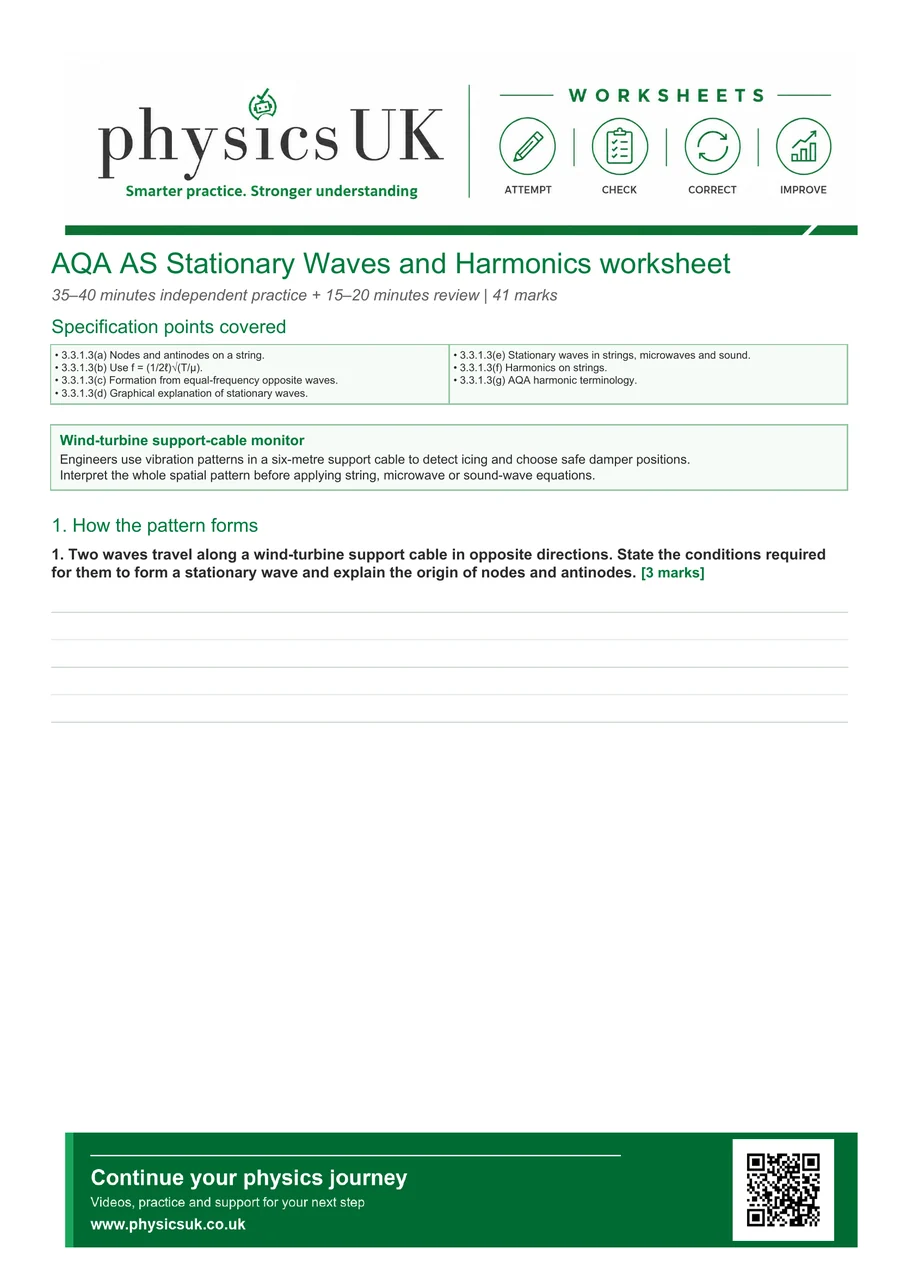
What is covered
Questions and skills covered
The worksheet contains 5 pages of printable questions. A separate 5-page solutions PDF makes it easy to mark, review or share answers after the activity.
- Formation of stationary waves by superposition
- Nodes, antinodes, phase and harmonic patterns
- Wave speed, string tension and mass-per-unit-length calculations
- Testing the stretched-string relationship experimentally
About this activity
The activity uses vibration patterns in a wind-turbine support cable to connect nodes, antinodes and harmonics to an engineering problem. Questions develop from explaining superposition to string calculations, microwave and sound patterns, and practical planning.
Before you start
Recall wavelength, frequency, wave speed and phase difference. Distinguish a picture of displacement along a wave from the motion of one particle over time.
A question from the worksheet
Question 1, worksheet page 1
Two waves travel along a wind-turbine support cable in opposite directions. State the conditions required for them to form a stationary wave and explain the origin of nodes and antinodes.
Show the answer
The waves have the same frequency and equal amplitudes and travel in opposite directions. Superposition produces fixed positions of destructive interference, called nodes, and maximum-amplitude positions, called antinodes.
Common error: A reflected wave alone is not a stationary wave. The pattern results from superposition of waves travelling in opposite directions.
Revise the physics
Specification fit
AQA AS Physics Worksheets
7407 · 3.3.1.3
Classroom use
Use the worksheet for class practice, homework, intervention, cover work or revision. Keep the PhysicsUK attribution intact when sharing copies with pupils.