
OCR A H556 · Module 4 · Section 4.1
Charge and current
Build current from moving charge, then connect microscopic charge carriers to the readings in a circuit. Predict first, change the model and use the result to explain what is happening.
How to use this resource
A three-pass learning route
Predict
Say what should happen to current or drift speed before moving a control.
Test
Change one variable, read the live values and compare with your prediction.
Explain
Use charge conservation, number density or cross-sectional area in your explanation.
Part 1
Charge flow, quantisation and current
Current is a rate
Current is the rate at which charge passes a point. One ampere means one coulomb passes each second. A component does not use up current: charge enters and leaves at the same average rate in steady conditions.
Charge is quantised
The elementary charge has magnitude e = 1.60 × 10⁻¹⁹ C. The charge on an isolated object is an integer multiple of e. Electrons carry −e; protons carry +e.
Which particles move?
In a metal, mobile electrons drift through a lattice of positive ions. In an electrolyte, positive and negative ions move in opposite directions; both movements contribute to conventional current.
Current direction
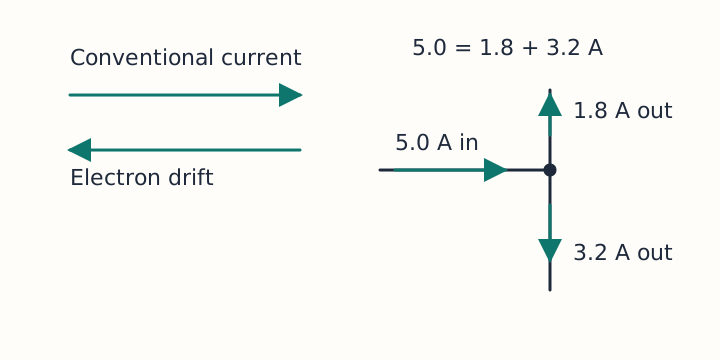
Conventional current is defined as the direction positive charge would move. It therefore points opposite to electron drift in a metal.
Part 2
Kirchhoff’s first law
At a junction, the total current entering equals the total current leaving. This is a consequence of conservation of charge.
Interactive investigation
Mean drift velocity laboratory
Predict → change → check
Predict what happens to drift velocity when current increases, wire area increases or carrier number density falls. Then test one change.
Active check
Balance the junction
Currents of 2.4 A and 0.85 A enter a junction. A current of 1.10 A leaves through one branch. What current leaves through the other branch?
Part 3
From charge carriers to current
Here A is cross-sectional area in m², n is the number of mobile charge carriers per cubic metre, e is charge per carrier and v is mean drift velocity.
Conductors
Have a large number density of mobile charge carriers, so current can be substantial even when drift speed is small.
Semiconductors
Have fewer mobile carriers than metals. Temperature and doping can change the carrier number density strongly.
Insulators
Have extremely few mobile charge carriers under ordinary conditions.
Worked examples
Exam calculations with reasoning
1. Charge passing a point
A current of 0.35 A flows for 4.0 minutes. Calculate the charge.
Convert time first: t = 240 s. Then Q = It = 0.35 × 240 = 84 C.
2. Number of electrons
A pulse transfers 3.2 μC. The number of electrons is N = Q/e = 3.2 × 10⁻⁶ / 1.60 × 10−19 = 2.0 × 10¹³.
3. Mean drift velocity
A 1.5 mm² metal wire carries 3.0 A. For n = 8.5 × 1028 m−3, v = I/Ane = 3.0 / [(1.5 × 10⁻⁶)(8.5 × 1028)(1.60 × 10⁻¹⁹)] = 1.47 × 10⁻⁴ m s−1.
Original exam-style practice
Retrieve, calculate and explain
These questions use recurring OCR assessment patterns without reproducing copyrighted past-paper questions.
Q1. Is a charge of 7.2 × 10⁻¹⁹ C possible on an isolated object? Explain.
No. Dividing by e gives 4.5, which is not an integer. Net charge must be an integer multiple of the elementary charge.
Q2. A wire’s diameter doubles while current and carrier density stay constant. What happens to drift velocity?
Area is proportional to diameter squared, so area becomes four times larger. From I = Anev, drift velocity becomes one quarter as large.
Q3. Explain why current is not used up by a lamp.
The lamp transfers energy from the charges to other stores, but charge is conserved. In steady conditions, the same current enters and leaves the lamp.
Q4. Why can a semiconductor have a much larger drift velocity than a metal for the same current and area?
A semiconductor can have a much smaller mobile-carrier number density. Since v = I/Ane, a smaller n requires a larger v for the same I and A.
Quick check: which statement is correct?
Which change alone doubles drift velocity?
OCR A specification coverage
Section 4.1 checklist
- 4.1.1(a) Define electric current as the rate of flow of charge, I = ΔQ / Δt.
- 4.1.1(b) Define the coulomb as the unit of charge.
- 4.1.1(c) Know that the elementary charge e equals 1.6 × 10⁻¹⁹ C and that electrons and protons carry charges −e and +e respectively.
- 4.1.1(d) Understand that net charge on a particle or object is quantised and a multiple of e.
- 4.1.1(e) Understand current as the movement of electrons in metals and movement of ions in electrolytes.
- 4.1.1(f) Distinguish between conventional current and electron flow.
- 4.1.1(g) Apply Kirchhoff’s first law as the conservation of charge at a junction.
- 4.1.2(a) Define and understand mean drift velocity of charge carriers.
- 4.1.2(b) Use and apply I = A n e v, where n is the number density of charge carriers.
- 4.1.2(c) Distinguish between conductors, semiconductors and insulators in terms of number density of charge carriers.
Mastery check
- Define current and calculate charge, time or particle number.
- Distinguish conventional current from electron flow.
- Apply Kirchhoff’s first law using conservation of charge.
- Use I = Anev with correct SI units.
- Compare conductors, semiconductors and insulators using carrier number density.
Continue the OCR electricity sequence
Next, study Energy, power and resistance, then apply the ideas in Electrical circuits. The focused mean drift velocity guide gives extra I = Anev practice. Return to the OCR Module 4 hub or try A-level Physics problem-solving questions.
Written against the current OCR A Physics A H556 specification and informed by recurring themes in official OCR examiner reports. Questions on this page are original PhysicsUK practice.