
So it controls whether electrons are emitted and their maximum kinetic energy.
Quantum physics · Photoelectric effect
What controls the electrons?
Watch photoelectrons emerge with different speeds, then use an electric field to accelerate, slow or stop them.
By the end, you should be able to explain
Frequency sets the maximum energy; emission depth produces a spread of electron speeds.
Investigation 1
Watch photoelectrons leave the metal
Watch: wavelength changes electron energy; intensity changes how many are released.
Live photocell
Below threshold
Light on a metal cathode
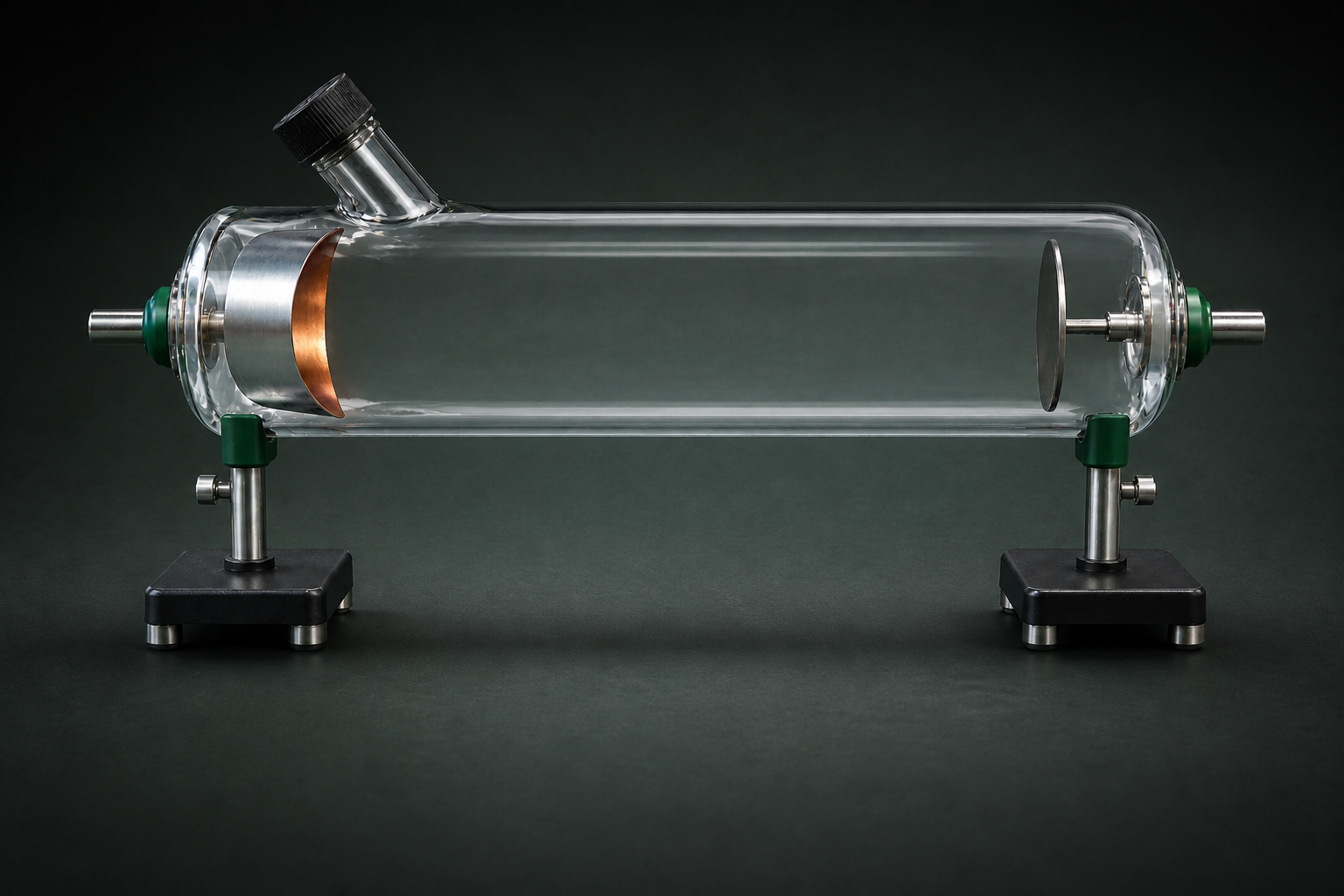
CathodeSodium
Collectorcollects electrons
650 nmred light
What you observe
Photon energy is too low to release electrons.
Photocurrent
→
Now add an electric field.
Reverse the polarity to accelerate or stop the electrons.
Investigation 2
How energetic are the fastest electrons?
Explore: a positive collector accelerates electrons; a negative collector slows them.
Sodium · 300 nm UV · no electric field
Electric field across the photocell
Current
+
−
Your live trace
measured current
Photocurrent against collector potential
Above threshold, this changes the photocurrent but not the stopping potential.
The fastest electrons are stopped when eVs = Ek(max).
Extension How can stopping potential give Planck's constant?Use several frequencies and plot Vs against f
From Einstein's equation
Vs = he f − φe
A straight-line graph of stopping potential against frequency has gradient h/e.
- Repeat the stopping-potential measurement for several frequencies.
- Plot Vs on the vertical axis and f on the horizontal axis.
- Multiply the gradient by e to estimate Planck's constant.